

 20 September, 2026
 Wedding reception timeline planning is the step-by-step scheduling of your reception from guest arrival to last dance so food service, speeches, music, and cultural moments run smoothly. It aligns vendors, locks key cues, and keeps energy high. At Mississauga Convention Centre, we tailor timelines to room flow, menu pacing, and our in-house AV support.
Quick Answer
Wedding reception timeline planning sets exact times for entrances, courses, toasts, and dances so your team, vendors, and venue move in sync. Hosting at 75 Derry Rd W in Mississauga, our seven elegant halls, in-house catering, and modern AV let us pace courses and cues precisely, keeping celebrations on track and unforgettable.
Summary
Plan a 4.5–6 hour reception with buffers around dinner, speeches, and formalities. Confirm vendor arrivals, designate a day-of captain, and align DJ/MC cues with catering service. Print a one-page run-of-show, and finalize headcount, dietary needs, and AV checks 72 hours prior for a calm, on-time celebration.
- What you’ll learn:
- Clear definition of wedding reception timeline planning and why it matters
- Step-by-step method to build schedules that actually hold
- Sample timelines for plated, buffet, cocktail-style, and multicultural receptions
- How to pace food service with speeches and dances
- Tools, templates, and on-site coordination tips you can use immediately
- Why this guide is different:
- Grounded in Mississauga Convention Centre’s real workflows at 75 Derry Rd W
- Integrates in-house AV, lighting, staging, and catering in one practical plan
- Addresses multicultural menus and traditions we host weekly across the GTA
- Immediate wins:
- Copy/paste schedules and checklists you can hand to vendors
- Room-flow and parking insights for over 2,200-guest capacity and ~700 spots
- Ways to avoid the 3 common causes of delays: late arrivals, speech overruns, and course bottlenecks
What Is Wedding Reception Timeline Planning?
Wedding reception timeline planning organizes every reception moment—cocktail hour, entrances, dinner, toasts, performances, and dances—into a precise schedule. It keeps vendors aligned, reduces delays, and ensures key traditions happen at the right time. A single page run-of-show shared with all parties is the most reliable format.
Here’s the core idea: a great reception feels effortless because it’s carefully timed behind the scenes. That timing is your timeline.
Core components of a strong timeline
- Fixed anchors: room open, grand entrance, dinner start, first dance, cake, late-night food, last dance.
- Variable segments: speeches, performances, cultural ceremonies, bouquet/garter alternatives, games.
- Vendor cues: DJ/MC song cues, lighting looks, photo/video moments, catering course releases.
- Buffers: 5–10 minute cushions between major moments to absorb natural drift.
- Ownership: a day-of captain who says “go” or “hold.” At our venue, that’s typically our floor manager coordinating with your planner.
Why it matters at our venue
- Scale: We operate seven halls of ~4,250 sq ft each with total capacity over 2,200 guests, so precision prevents bottlenecks.
- Catering diversity: South Asian, Pakistani Halal, Middle Eastern, Sri Lankan, Caribbean, and Continental menus each pace differently.
- Integrated AV: In-house sound, lighting, and staging link directly to your timeline for seamless cues.
Want to see how space impacts flow? Explore our wedding venue capacity guide to size segments correctly.
One-page format that travels
- Header: couple names, date, hall name, guest count, final headcount date.
- Columns: Time, Segment, Who’s Involved, Cue Notes, Backup Plan.
- Distribution: email PDF to all vendors and print 6 copies for MC, DJ, floor captain, and photo/video.
Why Wedding Reception Timeline Planning Matters
A precise reception timeline protects milestone moments and guest experience. It avoids common delays, keeps courses hot, and balances speeches with dancing. With integrated AV and catering, timelines ensure every cue lands on time—so the night feels effortless for you and memorable for guests.
Guest experience stays front and center
- Comfort: predictable pacing reduces long waits between courses and keeps speeches tight.
- Energy: spread high-energy moments—entrances, first dance, open dance—so the floor stays active.
- Accessibility: our ~700 on-site parking spots and clear arrivals minimize late starts.
Vendor alignment reduces risk
- Single source of truth: one timeline for catering, DJ, lighting, and photo/video avoids miscommunication.
- Sequenced cues: lights fade, doors open, and music hits at the same second.
- Recovery buffers: built-in cushions protect your main moments if something runs long.
Our in-house advantage
- On-site AV + staging: fewer vendors means faster setup and synchronized looks.
- Diverse kitchens: teams used to halal and multicultural menus coordinate with your MC for perfect releases.
- Hall flexibility: seven elegant spaces let us tailor entrances, photo ops, and room flips without losing time.
Planning your venue choice? Our event venue checklist maps directly to the timing factors that matter most.
How Wedding Reception Timeline Planning Works (Step-by-Step)
Build your reception timeline by locking anchors, sequencing dinner service, slotting speeches between courses, and adding buffers. Confirm vendor arrivals, test AV cues, and assign a day-of captain. Distribute a one-page run-of-show to all vendors 72 hours in advance and reconfirm key moments during room rehearsal.
Step 1: Lock anchors
- Pick ceremony end + travel time: If onsite, plan 15–30 minutes for photos and room flip.
- Set reception window: 4.5–6 hours is typical for smooth pacing.
- Fix immovable moments: grand entrance, first dance, cake, late-night snack, last dance.
Step 2: Sequence dinner service
- Plated: couple entrance → welcome toast → salad → two short speeches → main → two short speeches → first dance.
- Buffet: stagger tables by MC call; target shorter speech blocks to keep guests moving.
- Cocktail-style: more micro-moments (toasts, performances) spread over the evening.
Step 3: Place speeches and spotlight moments
- Short blocks win: 2–3 speeches per block between courses maintain attention.
- Video/performances: schedule just before dessert for captive audience and strong photo ops.
- Traditions: spotlight entrances, parent dances, or cultural ceremonies with clear MC scripts.
Step 4: Add buffers and backups
- 5–10 minutes: between major moments.
- Backup tracks: keep short instrumental versions ready for trims if needed.
- Alternate sequence: swap dessert and dance set if service slows unexpectedly.
Step 5: Confirm arrivals and tech
- Vendor windows: DJ, photo/video, décor, and cake arrivals staggered to prevent dock congestion.
- AV checks: sound checks, mic tests, projector preview, lighting looks.
- Venue walkthrough: final path for grand entrance and couple’s private plate service.
Step 6: Distribute and rehearse
- Send 72 hours prior: one-page run-of-show PDF to all vendors.
- Onsite huddle: 20-minute run-through with our floor captain and your MC.
- Print spares: place one at DJ booth, one at the head table, one with catering.
New to venue planning? Our wedding venue rental overview explains how room flow and staging support these steps.
Reception Styles and Timeline Approaches
Match your timeline to service style: plated for structured speeches; buffet for flexible pacing; cocktail-style for mingling; and multicultural receptions for layered traditions. Each requires tailored course timing, MC scripts, and AV cues to keep food hot and the dance floor energized.
Plated dinner reception
- Strengths: predictable pacing, elegant feel, clear speech windows.
- Watch-outs: keep speeches short between courses to serve mains hot.
- Sample anchors: 6:00 cocktails → 7:00 entrance → 7:10 welcome → 7:20 salad → 7:35 two toasts → 7:50 main → 8:20 two toasts → 8:35 first dance → 8:45 open dance → 9:30 dessert → 11:30 last dance.
Buffet reception
- Strengths: guest choice, potentially faster service for large counts.
- Watch-outs: avoid long lines—stagger by tables, open two sides.
- Sample anchors: 6:00 cocktails → 7:00 entrance → 7:10 buffet open (tables by call) → 7:40 welcome → 8:05 two toasts → 8:30 first dance → 8:40 open dance → 9:15 dessert stations → 11:30 last dance.
Cocktail-style reception
- Strengths: social vibe, continuous movement, great for photo/video.
- Watch-outs: be intentional with mini-moments or milestones feel lost.
- Sample anchors: 6:00 cocktails/heavy apps → 6:45 entrance → 7:00 toast → 7:30 performance → 8:00 first dance → 8:10 dance set → 9:00 late-night station → 11:00 sparkler farewell.
Multicultural receptions (South Asian, Pakistani Halal, Sri Lankan, Middle Eastern, Caribbean)
- Strengths: rich traditions, vibrant performances, family-centered program.
- Watch-outs: multiple entrances, blessing ceremonies, or tea/coffee traditions extend run-time—plan extra buffers.
- Sample anchors: 6:00 cocktails → 7:00 family processional → 7:15 couple entrance to dhol or live music → 7:30 welcome → 7:40 course 1 → 7:55 two toasts → 8:15 course 2 → 8:35 cultural performance → 8:50 first dance → 9:00 open dance → 9:45 dessert/tea service → 11:45 last dance.
Choosing your menu next? Browse our wedding menu ideas to align courses with your chosen style.
Best Practices That Keep Receptions On Time
Protect the schedule by assigning a single captain, locking vendor arrivals, trimming speech blocks, and pairing catering service with MC cues. Place short, high-energy moments early, build 5–10 minute buffers, and print a one-page run-of-show for every station. Reconvene vendors 15 minutes before each anchor.
People and ownership
- One decision-maker: your planner or our floor captain makes real-time calls.
- MC script: include exact names, pronunciations, and order of entrances.
- Vendor huddles: 20 minutes pre-doors, then 15 minutes before key anchors.
Program and pacing
- Speech blocks: cap at 2–3 per block; hold extras for post-dinner.
- First dance timing: place within 15–30 minutes after main course to re-energize the room.
- Room flips: if needed, schedule a natural buffer (dessert station or photo-ops).
AV + lighting
- Mic plan: two wireless handhelds + one lapel for officiant-style speakers.
- Looks: preset lighting scenes for entrances, toasts, and open dance.
- Playback: organize tracks by segment with 10-second pre-rolls for MC talk-over.
Catering and service
- Course alignment: avoid speeches beyond 7 minutes when mains are at the pass.
- Dietaries: flag halal, vegetarian, vegan, gluten-free, and allergen notes 7–10 days in advance.
- Private plate: serve the couple shortly after entrance so they can enjoy and then circulate.
Tools, Templates, and Resources
Use a one-page run-of-show, vendor contact sheet, MC script, and floor plan annotated with power and path-of-travel. Share editable files 1–2 weeks out, then lock a final PDF 72 hours before the event. Store backups with your DJ and venue captain.
Editable templates (copy these into your docs)
- Run-of-show (one page): Time | Segment | Who’s Involved | Cue Notes | Backup Plan
- Vendor contact sheet: Role | Company | Onsite Lead | Phone | Arrival Window | Notes
- MC script: Entrances order, name pronunciations, cue words, and timing estimates
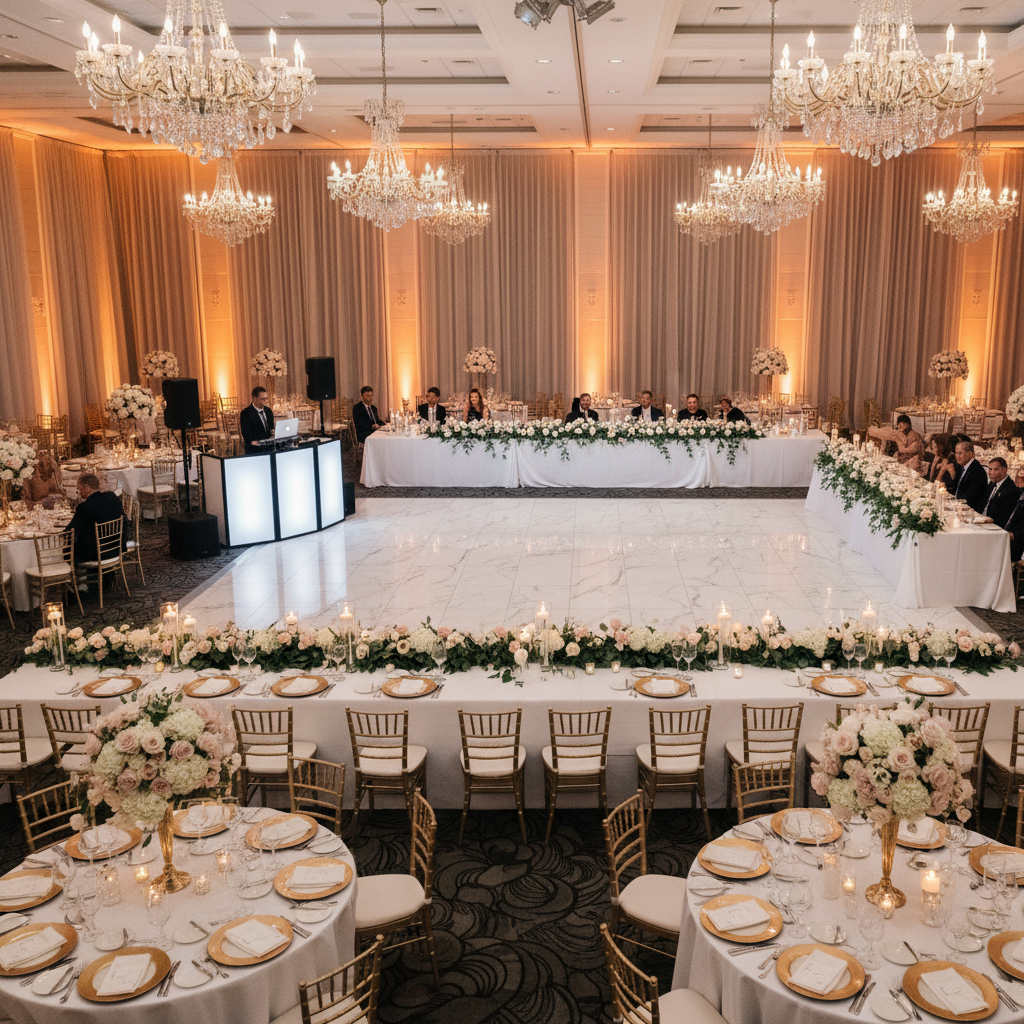
- Floor plan: head table, dance floor, DJ booth, buffet or stations, photo booth, dessert/tea/coffee
Software and planning aids
- Shared calendar: hold dates and vendor arrival windows.
- Cloud drive: timeline, scripts, and menus in a single shared folder.
- Virtual tour: pre-visualize flow; our team can walk you through room options.
What to confirm 72 hours before
- Final headcount + dietaries: align course volumes and dietary plates.
- Song files + backups: first dance, parent dances, entrance music.
- Staging/AV: mic count, lectern, projector, uplighting colors, and looks.
Sample Timelines You Can Use Today
Start with a 6-hour model: 6:00 cocktails, 7:00 entrances, 7:15 welcome, 7:20 salad, 7:35 toasts, 7:50 main, 8:30 first dance, 8:40 open dance, 9:30 dessert, 11:30 last dance. Adjust for service style, traditions, and entertainment while protecting anchors.
Plated dinner, classic flow (6 hours)
- 5:30 Vendor huddle and tech check
- 6:00 Cocktail hour, photo/video detail shots
- 7:00 Grand entrance + head table seating
- 7:10 Welcome toast (2–3 minutes)
- 7:20 Salad service
- 7:35 Two short speeches (3–4 minutes each)
- 7:50 Main course
- 8:20 Two short speeches (3–4 minutes each)
- 8:35 First dance → Parent dances
- 8:50 Open dance set
- 9:30 Dessert + coffee/tea station
- 11:30 Last dance and farewell
Buffet reception, energetic flow (5.5–6 hours)
- 5:45 Vendor huddle, mic tests
- 6:15 Cocktail hour begins
- 7:00 Entrance + buffet opens in two-sided formation
- 7:40 Welcome + one short toast
- 8:05 Two short toasts
- 8:30 First dance → Dance set
- 9:15 Dessert stations open
- 11:15 Last dance
Cocktail-style, continuous celebration (5–5.5 hours)
- 5:30 Doors open with passed hors d’oeuvres and stations
- 6:15 Grand entrance + short toast
- 6:45 Performance or game moment
- 7:30 First dance
- 7:40 Dance set with intermittent toasts/performances
- 9:00 Late-night savory station
- 10:45 Sparkler farewell (venue permitting)
Multicultural reception, layered traditions (6–6.5 hours)
- 5:30 Family processional lineup + music check
- 6:00 Cocktail hour (tea/coffee available)
- 7:00 Family introductions + couple entrance (dhol or live music)
- 7:20 Course one
- 7:40 Blessing or cultural ceremony segment
- 7:55 Short toasts
- 8:15 Course two
- 8:35 Performance
- 8:50 First dance → Open dance
- 9:45 Dessert + tea/coffee service
- 11:45 Last dance
Catering Pacing: Timing Courses, Stations, and Late-Night
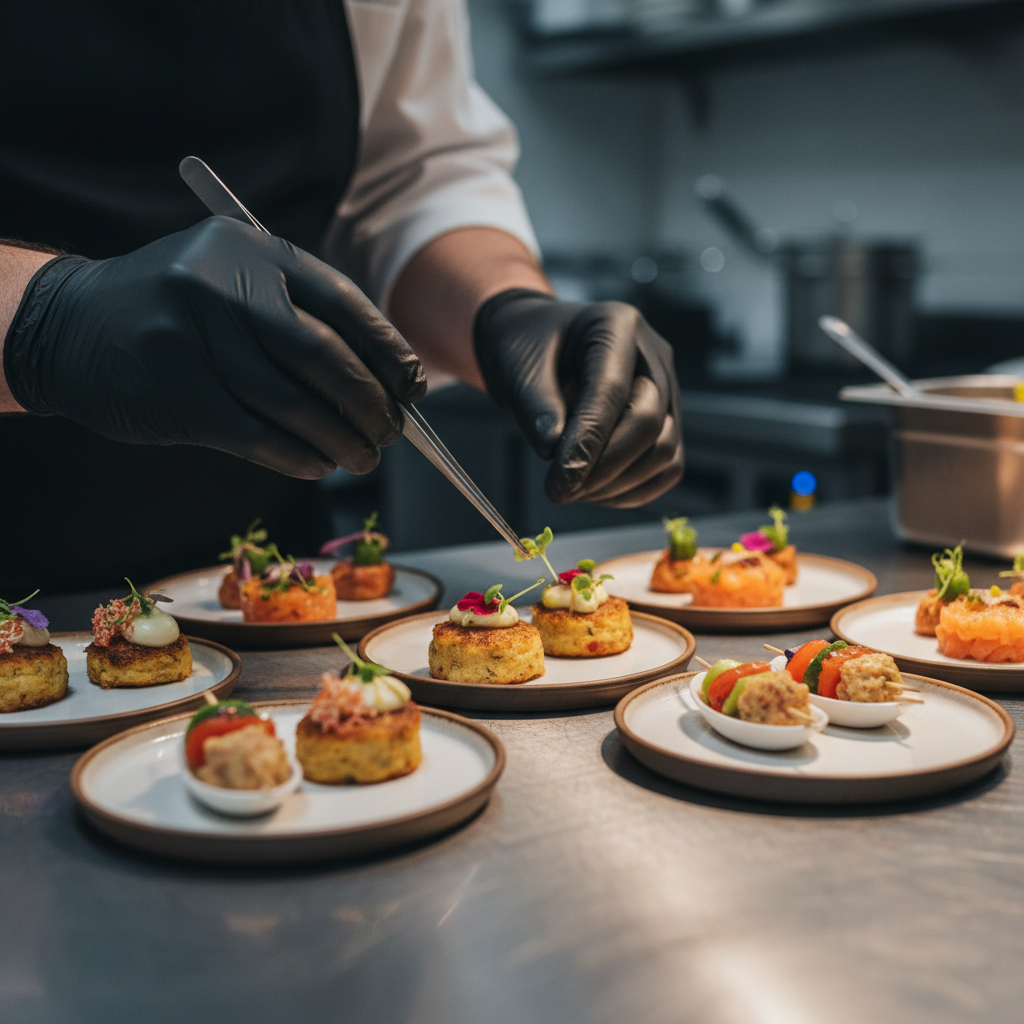
Align food service with your program. Serve salad soon after entrance, pause mains for brief toasts only, and restart music quickly post-main. Add dessert or tea/coffee during a natural lull, and open late-night stations 90–120 minutes before the end to re-energize the floor.
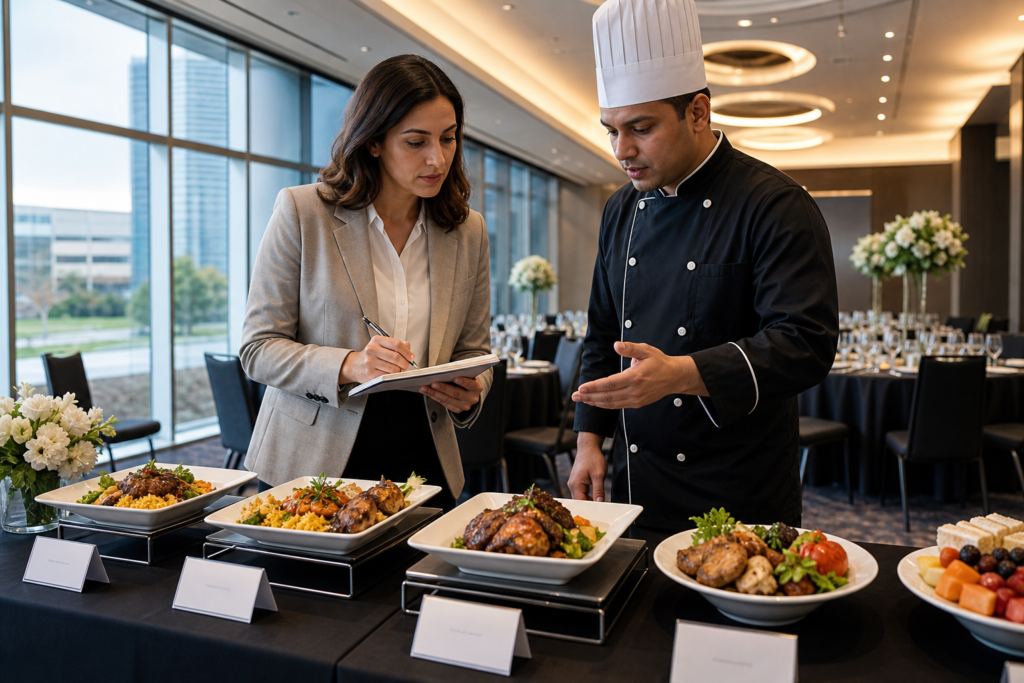
Our culinary teams coordinate directly with your MC so courses reach tables hot and speech windows don’t run into service. This is where integrated venue + catering truly pays off.
Plated service tips
- Short speeches between courses: keep 2–3 quick toasts; resume music quickly.
- Protect the main: avoid long talks when entrées are at the pass.
- Couple’s private plate: serve early so you can greet guests.
Buffet and stations
- Two-sided buffets: halve wait times by opening both sides.
- MC call order: stagger tables to prevent lines; offer family/elder priority.
- Stations mix: balance heavy and light options for constant flow.
Late-night bites
- Timing: open 90–120 minutes pre-farewell to lift energy.
- Menu: match culture and crowd—South Asian snacks, Middle Eastern favorites, Caribbean bites, or classic comfort.
- Placement: near dance floor perimeter to keep traffic moving.
AV, Lighting, and Music Cues
Tie each moment to a cue: lighting looks for entrances, toasts, and open dance; music stings for transitions; and microphone handoffs for speeches. Pre-program scenes and store playlists by segment so your MC, DJ, and AV tech can trigger on time without guesswork.
Entrance and introductions
- Track list: processional loop + couple’s custom entrance song.
- Lighting: doorway wash + spotlight at head table.
- Photo cue: pause 3 seconds at center for the shot.
Speeches and toasts
- Mics: two handhelds on stands; sanitize and swap efficiently.
- Podium: optional lectern for notes; check height and comfort.
- Playback: 10-second instrumental underlay for elegant intros.
Open dance lighting
- Scene change: warm uplights to saturated dance looks.
- First dance: soft spotlight; dim house lights for intimacy.
- Re-energize: lighting chase + DJ hype track after dessert.
Outdoor Patio and Seasonal Considerations
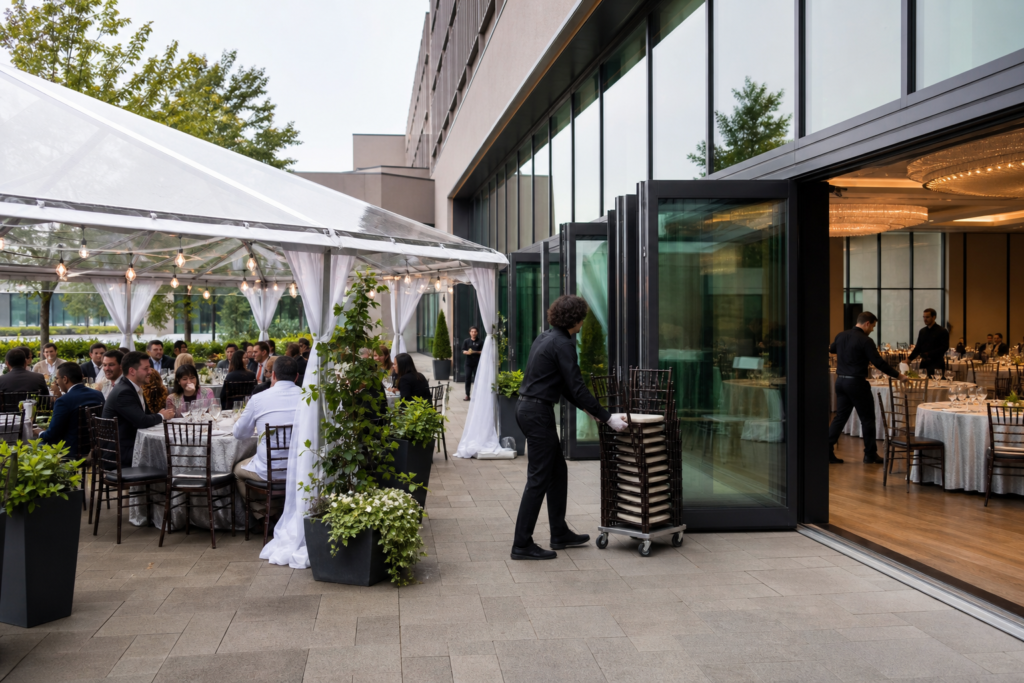
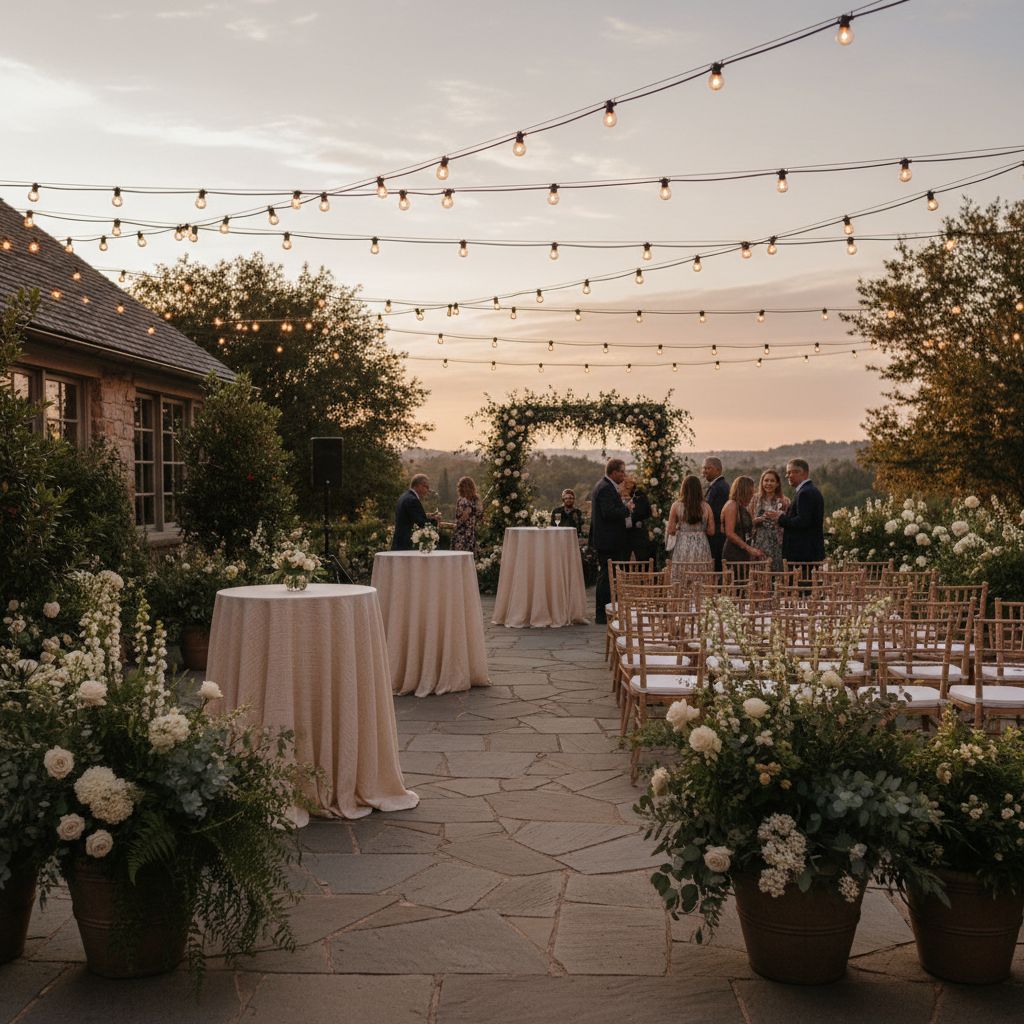
For patio ceremonies or cocktail hours, time your program around golden hour and add weather contingencies. Keep speeches indoors for audio reliability, and stage lighting for safe pathways after sunset. Always hold a weather-ready alternate room.
Golden-hour wins
- Photo timing: schedule couple portraits at sunset.
- Guest comfort: shade/heat plans in summer; heaters in cooler months.
- Sound: wind screens for mics; keep key speeches indoors if windy.
Backup plans
- Weather pivot: pre-assign an indoor hall for fast switch.
- Décor mobility: centerpieces and signage on move-ready bases.
- Power & paths: cable covers and lit walkways after dusk.
Flow and signage
- Wayfinding: clear paths from patio to ballroom and restrooms.
- Beverage plan: satellite bar to reduce lines after entrances.
- Sound spill: coordinate DJ levels between patio and ballroom.
Service Style vs. Timeline: Quick Comparison
Choose a service style that fits your timeline. Plated is structured with clear speech slots, buffet is flexible but needs line control, cocktail-style is social with micro-moments, and multicultural programs add traditions and performances that extend total run-time.
| Service Style | Best For | Timeline Impact | Key Tips |
|---|---|---|---|
| Plated | Formal elegance, predictable pacing | Clear anchors; speeches between courses | Keep speech blocks short; protect hot mains |
| Buffet | Guest choice, big headcounts | Flexible; needs table calls | Open two-sided lines; MC stagger calls |
| Cocktail-Style | Social vibe, constant motion | Micro-moments over 5–5.5 hours | Plan mini toasts/performances often |
| Multicultural | Traditions + performances | Extended run-time; added segments | More buffers; script ceremonies clearly |
Mini Case Studies and Real Examples
Real receptions at 75 Derry Rd W show how pace, AV, and service come together. By pairing short speech blocks with course timing and rehearsed cues, couples preserved hot meals, full dance floors, and on-time farewells—even with complex cultural programs.
Elegant plated dinner, 320 guests
- Challenge: multiple family speeches threatened main-course temperature.
- Solution: we split speeches into two blocks and cued mains immediately after the first block.
- Result: hot entrées, 12-minute transition to first dance, packed floor by 8:45.
Buffet with performances, 500+ guests
- Challenge: potential long lines and program overruns.
- Solution: two-sided buffet, MC table calls, performance staged post-course two.
- Result: seating cleared in ~25 minutes, program landed exactly at 11:15 last dance.
Multicultural reception with tea and blessing ceremonies
- Challenge: layered traditions expanded total run-time.
- Solution: added buffers, moved one ceremony to cocktail hour, and centralized speeches.
- Result: smooth pacing, no cold dishes, all key moments captured on schedule.
Local Tips
- Tip 1: For Friday events near 75 Derry Rd W, pad guest arrival by 15 minutes to account for Highway 401/410 traffic and Toronto Pearson airport flow.
- Tip 2: In winter months, plan coat check and a warm beverage station at doors; it keeps guests comfortable and prevents delays at the ballroom entrance.
- Tip 3: Using our outdoor patio, schedule golden-hour photos and hold a weather-ready indoor hall—our team flips signage fast if wind or rain picks up.
IMPORTANT: These tips reflect real guest flow and seasonal patterns around our Mississauga location.
Free Planning Help (Soft CTA)
Want a custom run-of-show built to your menu and program? Our coordination team at 75 Derry Rd W will map cues, buffers, and service timing to your vision.
Start with our wedding venue overview and we’ll align a draft timeline to your chosen hall.
Wedding Reception Timeline Planning: FAQs
Strong reception timelines balance food service, speeches, and dancing with buffers between each milestone. Keep speech blocks short, lock vendor arrivals early, and print a one-page run-of-show. Rehearse cues with your MC and venue captain for an on-time, joy-filled night.
How far in advance should we finalize the reception timeline?
Lock your baseline 4–6 weeks out, then publish a final PDF 72 hours prior. This window lets you confirm final headcount, dietaries, and AV checks with our team so catering and cueing align.
Where should we place speeches so dinner stays hot?
Insert 2–3 short speeches between salad and main, then 2–3 between main and dessert. Avoid long blocks when mains are at the pass. Your MC should be ready to trim if service needs to move.
What if our program includes cultural ceremonies and performances?
Plan extra buffers and consider moving one ceremony to cocktail hour. Script transitions, pre-stage props, and align lighting/music cues. Our floor captain will coordinate with your MC to keep momentum.
When should we schedule the first dance?
Place it 10–20 minutes after the main course to re-energize the room and invite guests to the floor. Pair it with parent dances and then launch an open dance set.
Do we need a printed run-of-show if we shared it digitally?
Yes. Venue teams, DJs, and photo/video love a one-page printout at key stations. It prevents phone hunting mid-event and keeps everyone synced at a glance.
Conclusion
An on-time, joy-filled reception comes from a clear, shared plan. Lock anchors, pace service with short speech blocks, add buffers, and rehearse cues. With integrated catering and AV, Mississauga Convention Centre turns timelines into seamless celebrations.
- Key Takeaways
- Protect anchors and place speeches between courses.
- Use 5–10 minute buffers between milestone moments.
- Distribute a one-page run-of-show 72 hours before.
- Rehearse cues with your MC and our floor captain.
- Next steps
- Share your draft timeline with our team for review.
- Align menu pacing to your chosen program.
- Book a walkthrough to finalize entrances and cues.
Ready to map your day? Explore hall options and room flow in our wedding venue overview, skim the capacity guide, and choose menu pairings from our wedding menu ideas. We’ll turn your plan into a timeline guests feel—and remember.
Plan with Us at 75 Derry Rd W
Book a discovery session in Mississauga to align your reception timeline with the right hall, menu pacing, and AV looks. Our team specializes in multicultural receptions across the GTA.