

 20 September, 2026
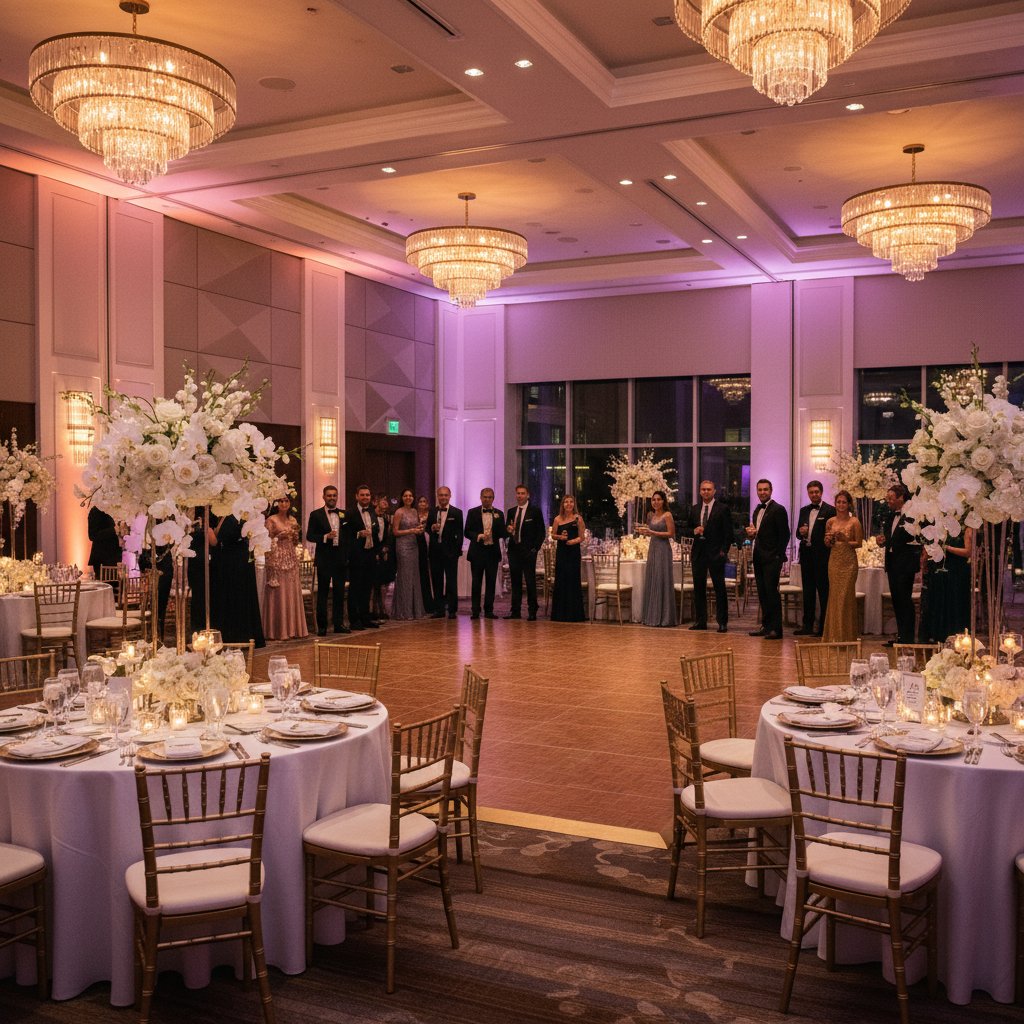
 You’ve got a guest list that keeps changing and a Pinterest board that won’t quit. But how do you match headcount to a room that actually fits—comfortably—without guesswork? This wedding venue capacity guide shows you exactly how to size your ceremony and reception using simple square-foot-per-guest math, sample floor plans, and practical checklists. It’s written with Mississauga Convention Centre’s real spaces in mind—seven elegant halls of about 4,250 square feet each (over 2,200 total guest capacity) at 75 Derry Rd W—so you can go from estimate to confident plan fast.
- Understand the difference between capacity, comfort, and flow
- Use square-foot-per-guest guidelines that planners rely on
- Map banquet, theater, classroom, and cocktail layouts to real numbers
- Right-size dance floors, head tables, aisles, stages, and AV sightlines
- Account for buffet stations, bars, photo booths, and décor
- Apply the math to Mississauga Convention Centre’s seven halls
- Turn capacity decisions into action with checklists and timelines
This wedding venue capacity guide aligns with how our team runs weddings every week—from intimate 120-guest dinners to 800+ guest South Asian celebrations with Mandaps, live entertainment, and multicourse in-house catering. Use the steps below, then validate your plan with a virtual tour and on-site walkthrough.
Overview
- Who this helps: Couples, planners, and families organizing ceremonies and receptions in the GTA.
- Where this applies: Mississauga Convention Centre at 75 Derry Rd W—near major highways and Toronto Pearson International Airport.
- What you’ll use: Simple formulas, proven layout ratios, and on-site checks (stage, AV, and décor).
- Result: A right-sized room with smooth flow, clear sightlines, and happy guests.
Quick Answer
The fastest way to size your wedding is to multiply your guest count by a layout’s typical square feet per guest, then subtract space for dance floor, head table, bars, and décor. At our 75 Derry Rd W location, seven ~4,250 sq ft halls (2,200+ total capacity) let you match small, medium, or large guest lists with room to breathe—backed by AV, staging, and diverse in-house catering.
What Is Wedding Venue Capacity?
Capacity is the safe and comfortable number of people a room can host given your layout, furniture, and activities. It’s not just a fire-code figure—it’s how the space actually works with tables, chairs, a dance floor, and wedding flow.
- Fire and life safety limits: Set the absolute maximum number of people based on egress and codes.
- Functional capacity: Adjusts for layout choices (rounds of 8 vs. 10), circulation, and features like a head table or Mandap.
- Comfort capacity: Targets your ideal guest experience—no cramped aisles, no blocked views, and smooth service.
- Why this matters: Better comfort equals better energy, photos, and service speed. Guests mingle, servers move, and your program stays on time.
At Mississauga Convention Centre, we help you calculate all three—then choose the setup that keeps your celebration elegant and easy to enjoy.
Why Capacity Planning Matters
Right-sizing your venue prevents the two big day-of regrets: a room that feels crowded or a room that feels empty. Both affect mood, movement, and memories.
- Energy and ambiance: A properly filled room enhances music, toasts, and dance floor momentum.
- Service quality: Clear server aisles speed up courses, refills, and dessert timing.
- Photo/video angles: Sightlines around head tables, stages, and Mandaps stay open for media teams.
- Program flow: Seamless transitions (ceremony to cocktail to dinner to dancing) reduce downtime and guest confusion.
- Accessibility: Wheelchair turning radii, stroller paths, and elder seating are easy to accommodate when planned early.
Here’s the thing—capacity decisions are tough to reverse once linens are pressed and seating charts are printed. Doing the math now saves stress later.
How Wedding Venue Capacity Works (The Math You’ll Actually Use)
Use square-foot-per-guest guidelines, then subtract dedicated areas (dance floor, stage, DJ, bars, buffets, photo backdrops). The remaining area is guest seating and circulation.
Typical Square Feet Per Guest (Planning Ranges)
- Banquet rounds of 10: 10–12 sq ft per guest (12–14 for premium spacing)
- Banquet rounds of 8: 12–14 sq ft per guest
- Cocktail/standing: 6–10 sq ft per guest (stations at higher end)
- Theater/ceremony: 6–8 sq ft per guest (add aisle width + stage)
- Classroom (with tables): 14–18 sq ft per guest
These planning ranges reflect both comfort and circulation. We’ll tailor them during your walkthrough based on head table, entertainment, and service style.
Dance Floor, Stage, and Special Areas
- Dance floor: Plan 2–4 sq ft per guest or 8–12 sq ft per expected dancer at peak (often 30–40% of guests). Choose the larger result.
- Head table with backdrop: Allow 6–8 feet of depth plus backdrop space. Linear seating needs 2.5–3 feet per person.
- Stage/platform: Entertainment needs vary; bands and cultural performances often need 12’–24’ width with safe egress.
- Bars and buffets: Reserve 100–200 sq ft per station depending on service style and queuing.
- Photo booth/backdrops: 80–120 sq ft plus a small queue.
Pro tip: sketch these as blocks on your floor plan before placing tables. It keeps sightlines clean and avoids aisle pinch points.
Fast Formula (Step-by-Step)
- Start with room square footage. Example: one Mississauga Convention Centre hall ≈ 4,250 sq ft.
- Subtract fixed areas. Dance floor, stage, DJ, bars, buffets, backdrops, and AV control.
- Choose your layout SF/guest. Use 10–12 for rounds of 10; 12–14 for rounds of 8.
- Divide remaining space by SF/guest. That’s your functional seating capacity.
- Pressure-test with a diagram. Check aisles, servers’ paths, and emergency egress.
Example: 4,250 sq ft – 700 sq ft (dance floor + stage + bars) = 3,550 sq ft. Using 12 sq ft/guest ≈ ~295 seated guests with good comfort.
Types of Wedding Layouts (And When to Use Each)
Different moments need different layouts. Mix and match across rooms or phases for the best flow.
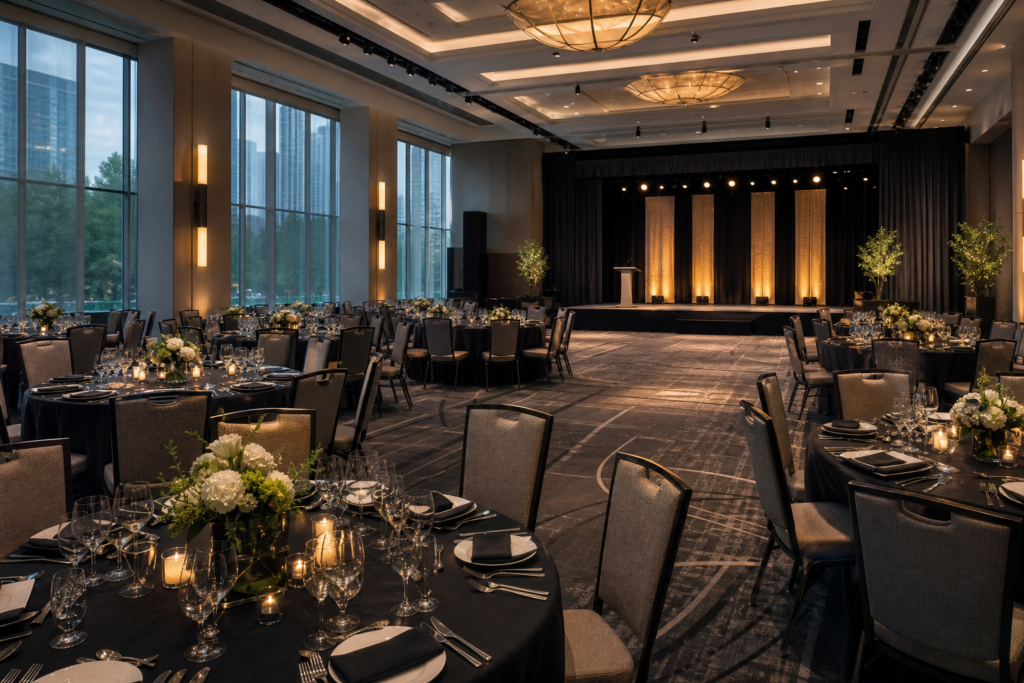
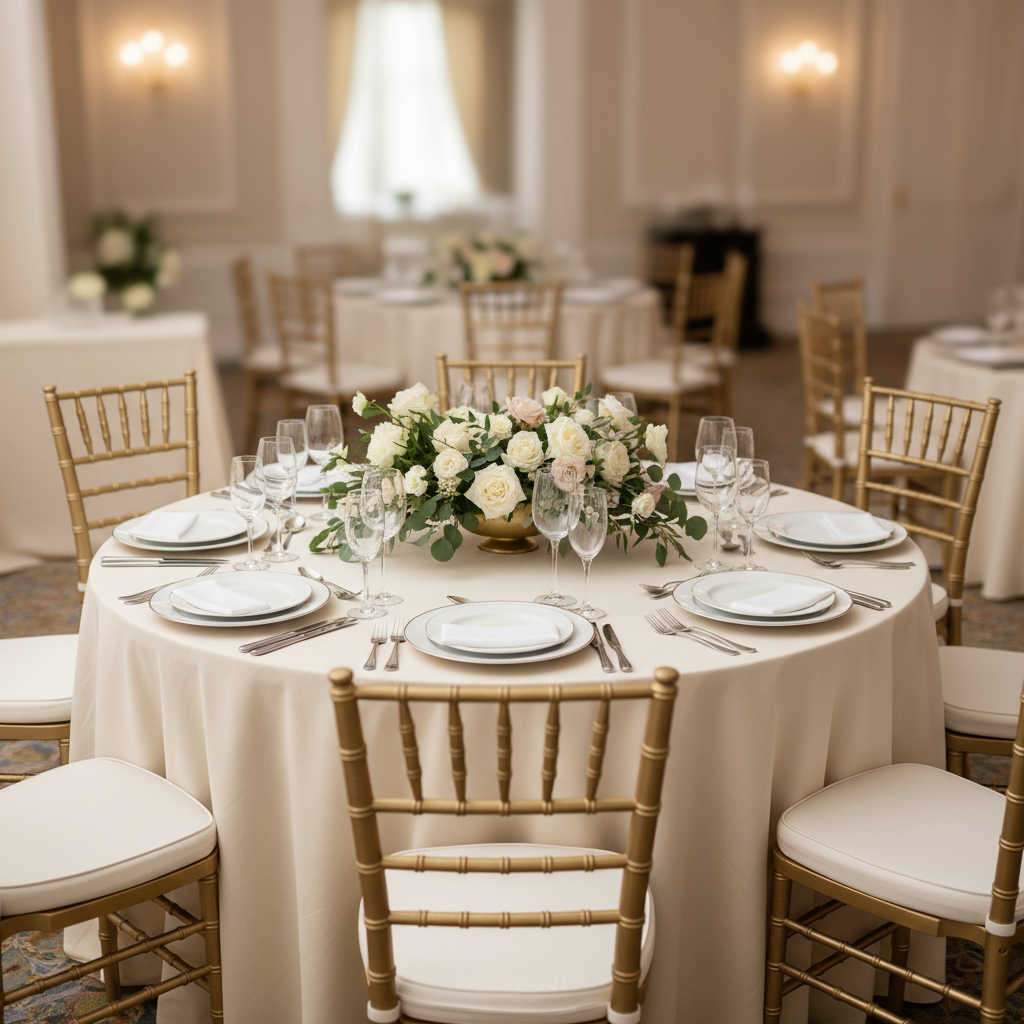
Banquet Rounds (Dinner Reception)
- Best for: Seated dinners, formal speeches, family-style or plated service.
- Capacity cue: Rounds of 10 use 10–12 sq ft/guest; rounds of 8 use 12–14.
- Comfort upgrades: Wider aisles near the head table, service stations tucked behind pillars, and thoughtful highchair/wheelchair placements.
- Real example: One 4,250 sq ft hall with rounds of 10 and a 400 sq ft dance floor seats ~300 comfortably. Two combined halls can support 550–650 depending on stage and bars.
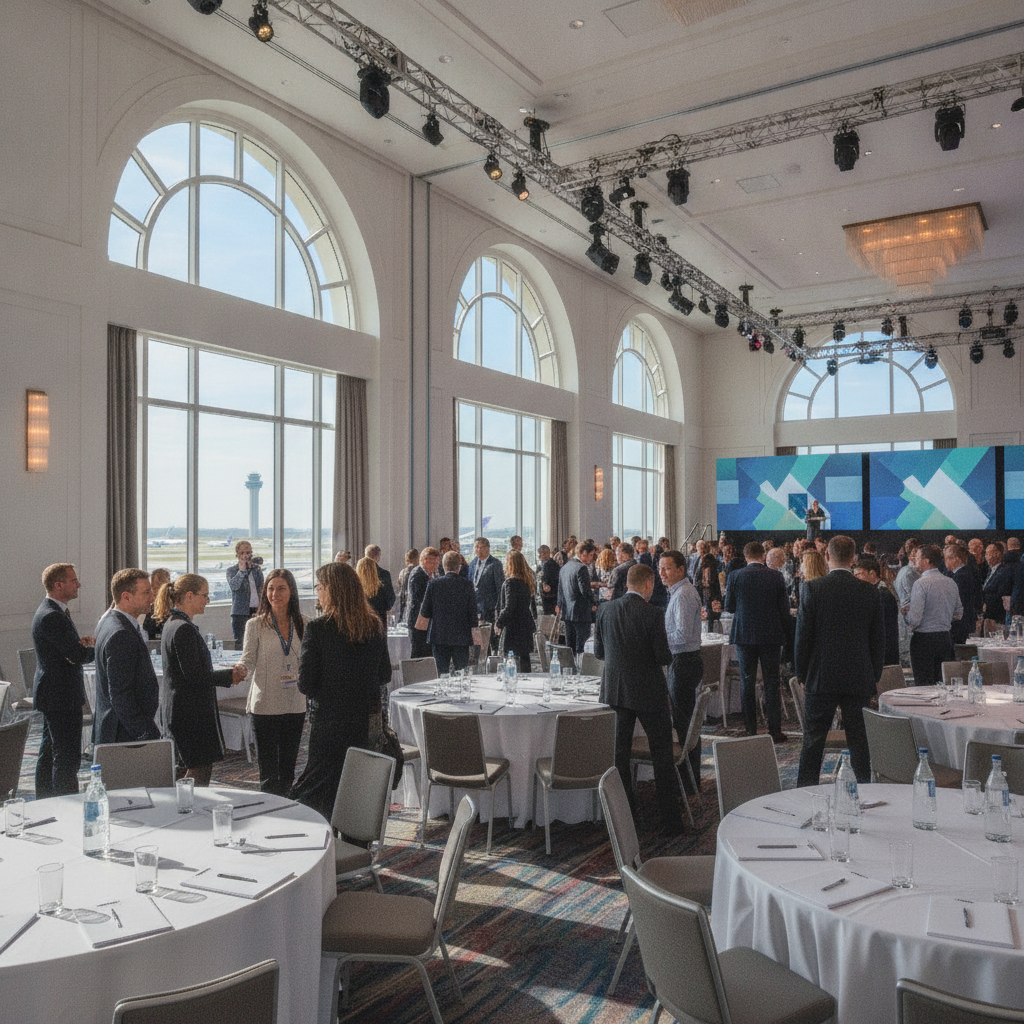
Cocktail-Style (Standing Receptions)
- Best for: Lively, social-forward evenings with passed canapés and stations.
- Capacity cue: 6–10 sq ft/guest. The more stations, the more space you’ll need.
- Tips: Add soft seating clusters near the bar for elders, and keep walkways open toward the dance floor.
- Real example: A combined two-hall footprint supports a 500-guest cocktail reception with multiple bar stations, dessert action station, and a 500–600 sq ft dance floor.
Theater/Ceremony Seating
- Best for: Indoor ceremonies, performances, or multimedia-heavy programs.
- Capacity cue: 6–8 sq ft/guest plus generous aisle widths for processions and photography.
- Tips: Align center aisle with the arch or Mandap; leave space for photographers at the front corners.
- Real example: Two connected halls host 600–800 ceremony chairs with a wide center aisle and stage, then flip to dinner while guests enjoy cocktails next door.
Classroom (Sangeet, Rehearsal Workshops, Multiday Events)
- Best for: Program segments that need writing space or tasting notes.
- Capacity cue: 14–18 sq ft/guest due to table depth and chair push-back room.
- Tips: Use for pre-wedding workshops or vendor run-throughs; switch to banquet later.
Capacity by Layout: Quick Comparison Table
Use this as a starting point. We’ll customize based on your décor, entertainment, and cultural elements.
| Layout | SF/Guest (Typical) | One Hall (~4,250 sq ft) | Two Halls (~8,500 sq ft) | Notes |
|---|---|---|---|---|
| Banquet Rounds of 10 | 10–12 | ~280–325 (less after subtracting dance floor/stage) | ~560–650 (less after subtracting shared features) | Use 12 for extra comfort and server aisles |
| Banquet Rounds of 8 | 12–14 | ~240–300 | ~480–600 | Slightly larger footprint per guest |
| Cocktail/Standing | 6–10 | ~425–700 | ~850–1,400 | Higher SF if heavy stations or décor |
| Theater/Ceremony | 6–8 | ~530–700 (plus aisle/stage) | ~1,060–1,400 | Add generous center and side aisles |
| Classroom | 14–18 | ~235–300 | ~470–600 | Use for programs, then flip to banquet |
Note: Numbers reflect raw square-foot math. Subtract specific features (dance floor, head table, stage, bars) for a final seating plan.
Step-by-Step: Right-Size Your Wedding at 75 Derry Rd W
Follow these steps with your current guest list and we’ll validate during a site visit.
1) Define Each Phase
- Ceremony: Indoor theater seating or outdoor patio chairs? Include aisle width and altar/Mandap depth.
- Cocktail: Standing circulation near bars and photo ops; soft seating near elders.
- Dinner + Dancing: Banquet rounds, head table, dance floor. Plan transitions and flip times.
2) List Non-Negotiables
- Culinary style: Plated, family-style, or buffet? Our in-house catering spans South Asian, Pakistani Halal, Middle Eastern, Sri Lankan, Caribbean, and Continental menus—each affects service flow differently.
- Cultural elements: Mandap/arch, dhol players, live band, or traditional performances—these impact stage and clearance.
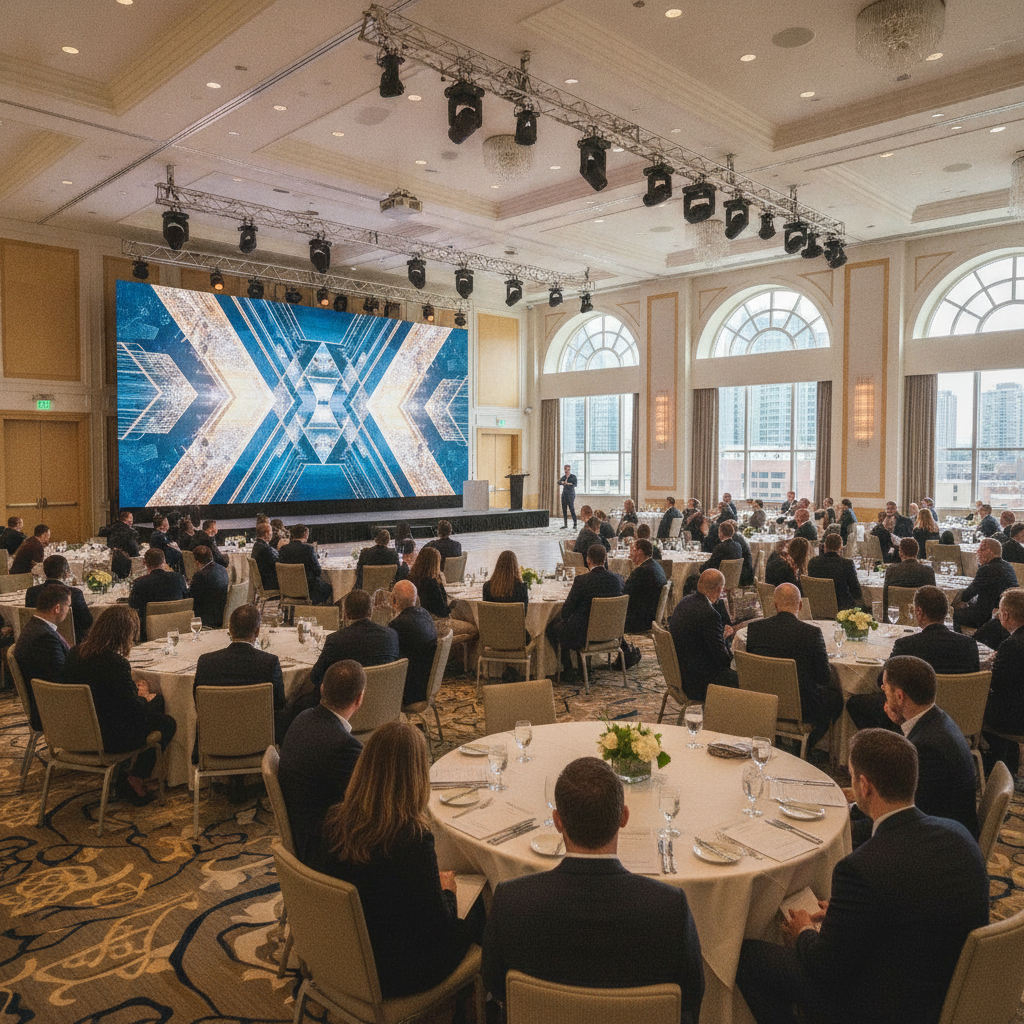
- AV moments: First look on LED, live feed for speeches, or ceiling wash lighting—reserve tech positions and unobstructed views.
3) Do the Math (Per Room)
- Pick a hall count: One hall (~4,250 sq ft) for intimate receptions; two or more for 400–800+ guest celebrations.
- Subtract fixed zones: Dance floor, stage, head table backdrop, bars, buffets, and photo areas.
- Apply SF/guest: Choose based on rounds of 8 vs. 10 and comfort target.
- Check egress and ADA-style clearances: Keep at least two wide paths around the room.
4) Pressure-Test Flow
- Server routes: Paths from kitchen access points to tables without crossing the dance floor.
- Speech angles: Camera positions and line of sight from tables to the head table or stage.
- Entertainment needs: Sound coverage, power access, and safe backstage access.
5) Validate On-Site
- Virtual tour first: Pre-visualize scale and lighting.
- Walkthrough: Measure key zones, tape out the dance floor, and test processional timing.
- Finalize diagram: Lock your seating map, then build the day-of run of show.
Best Practices for Capacity, Comfort, and Flow
Use these principles to avoid last-minute compromises.
- Prioritize aisle width: 5–6 feet minimum near head table and doors helps servers and elders move comfortably.
- Place bars smartly: Opposite corners reduce lines; don’t stack bars beside the dance floor entrance.
- Right-size the dance floor: Too small kills momentum; too large dilutes energy. Plan for peak dancers.
- Use rounds of 8 for premium space: Guests appreciate elbow room, especially with layered place settings.
- Balance décor with function: Grand backdrops and suspended florals are stunning—leave space for staff and safe egress.
- Segment acoustic zones: Position the DJ or band to avoid sound dead-spots and keep speeches intelligible.
- Mind accessibility: Confirm wheelchair seating, stroller parking, and sightlines from priority seats.
For design inspiration and venue-specific notes, see our overview on weddings at Mississauga Convention Centre and our feature on a Mississauga banquet hall wedding.
Tools and Resources (Use These Checklists)
Make decisions quickly with these working lists.
Capacity Calculator Inputs
- Guest count by phase: Ceremony, cocktail, dinner, late-night arrivals.
- Layout style per phase: Theater, cocktail, banquet, or mixed.
- Fixed zones: Dance floor, head table, stage, bars (count), buffets (count), photo areas.
- Comfort target: Standard vs. premium spacing (choose your SF/guest accordingly).
Diagram Checklist
- Mark doors, emergency exits, and service corridors
- Draw dance floor and head table at scale
- Place bars to split lines; add trash and water service points
- Reserve camera tripods and tech tables with clear sightlines
- Add stroller parking and wheelchair positions near family
Service Flow Checklist
- Can servers reach every table without crossing the dance floor?
- Are aisles consistent width, especially near the head table?
- Is late-night food near a bar (but not blocking it)?
- Is the grand entrance path clear and well-lit?
- Do elders have short routes to restrooms and exits?
Soft CTA: Want a fast sanity check on your numbers? Bring your estimated layout and guest list to a walkthrough—our team will validate dance floor size, table counts, and service flow in minutes.
Case Studies: Real Wedding Scenarios in Our Halls
Here are common setups we host and how capacity choices made the difference.
1) 280–320 Guests: Classic Reception in One Hall
- Layout: Rounds of 10, 12 sq ft/guest, 400 sq ft dance floor, compact DJ area.
- Flow win: We widened aisles near the head table for fast dinner service and kept bars in opposite corners.
- Cuisine: Continental menu with plated courses; streamlined service reduced traffic near the dance floor.
- Outcome: Room felt full but never congested; dance floor stayed active all night.
2) 450–600 Guests: South Asian Wedding, Two Halls
- Layout: Rounds of 8 for premium space, a 700–900 sq ft dance floor, and a raised stage for entertainment.
- Flow win: Mandap and backdrop placed to preserve sightlines; photo backdrop offset from the bar to prevent bottlenecks.
- Cuisine: Pakistani Halal and Sri Lankan stations—service islands spaced to keep lines short.
- Outcome: Elegant look with authentic culinary experience and clean camera angles.
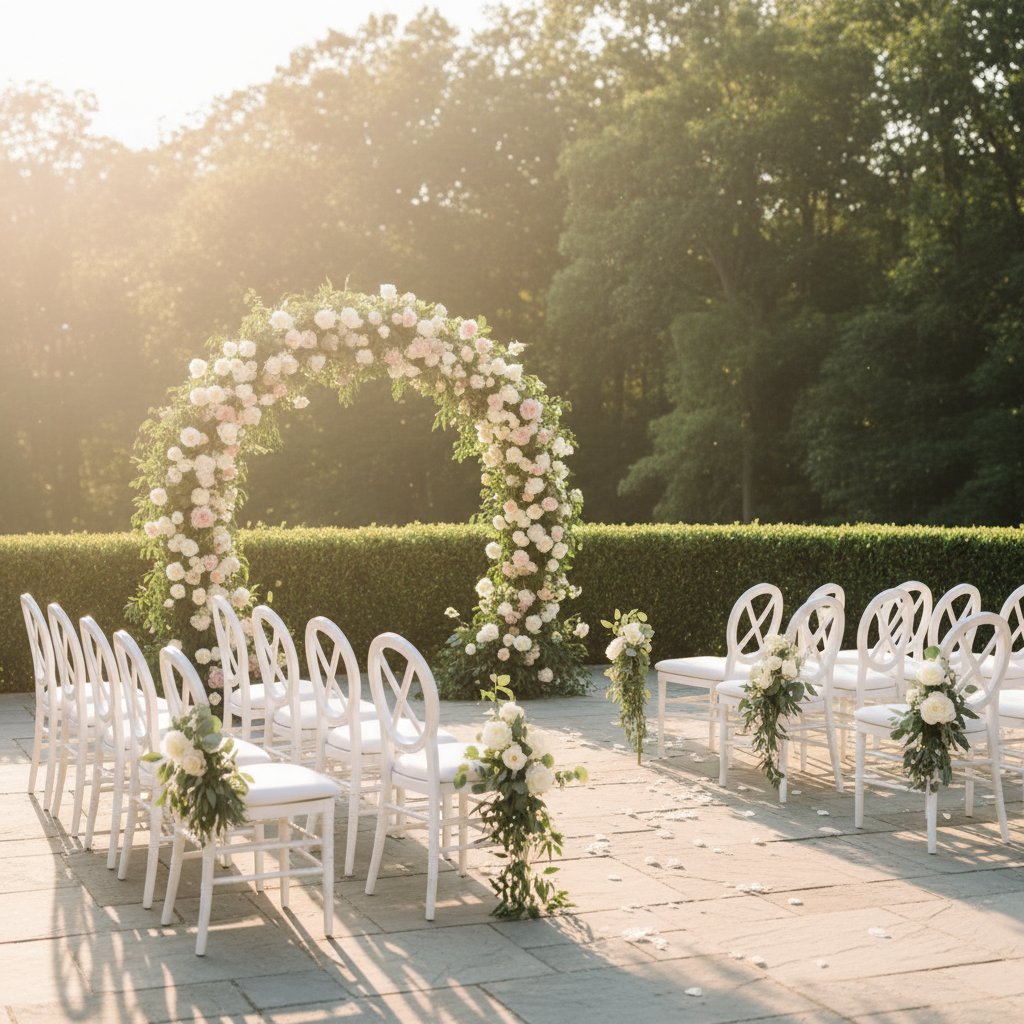
3) 120–160 Guests: Patio Ceremony + Dinner Indoors
- Layout: Outdoor ceremony seating with generous center aisle and floral arch; dinner in one hall with rounds of 10.
- Flow win: Golden-hour photos outdoors while room flip happened inside; guests transitioned through a staffed foyer bar.
- Cuisine: Middle Eastern menu with plated entrée and late-night dessert station.
- Outcome: Seamless day with weather flexibility and a stress-free flip.
Local Logistics: Parking, Access, and Timing
Details that change the guest experience—especially in the GTA.
- Parking: 700 free on-site spaces mean less time hunting for spots and more time on the dance floor.
- Airport access: Minutes to Toronto Pearson keeps travel simple for out-of-town guests and vendors.
- Highway network: Quick access from 401/403/410/407 supports smooth arrivals and vendor load-in schedules.
- Load-in/load-out: Coordinate staging and AV setup to protect aisles and head table placement.
Want venue-specific guidance and example floor plans? Explore our wedding venue Mississauga insights and browse inspiration tagged under wedding reception halls GTA.
Local Tips
- Tip 1: When visiting 75 Derry Rd W, plan arrivals around Derry Road and Hurontario St traffic windows; schedule your walkthrough just after rush-hour for a realistic load-in view.
- Tip 2: Peak GTA wedding season (late spring to early fall) fills weekends fast—lock ceremony times early, and allocate extra time for outdoor patio photos if sunset is part of your plan.
- Tip 3: For multicultural programs with live entertainment, share your run of show with our AV team early—staging, lighting, and tech positions influence table counts and capacity.
IMPORTANT: These tips are tailored to our location, on-site parking, and in-house AV/catering. They’ll help you protect capacity while elevating guest comfort.
Common Pitfalls (And How to Avoid Them)
- Overlooking fixed zones: Forgetting to subtract DJ, bars, and backdrops leads to cramped aisles. Block them out first.
- Underestimating dancers: If your crowd loves Bhangra or Soca, plan higher peak dancers and size the floor accordingly.
- Ignoring sightlines: Tall centerpieces, columns, and backdrops can hide the head table. Check from multiple angles.
- Tight bar clustering: Bars too close together cause long lines in one place. Split them to opposite corners.
- One-size-fits-all spacing: Rounds of 10 save room but may feel tight with elaborate place settings; rounds of 8 feel more premium.
Working With Our Team (What We Provide)
We design capacity around your story, not the other way around.
- Flexible halls: Seven similarly sized halls (~4,250 sq ft each) for modular combinations and parallel events.
- In-house AV and staging: Lighting design, audio coverage, and technical support keep programs crisp and on schedule.
- Diverse culinary options: South Asian, Pakistani Halal, Middle Eastern, Sri Lankan, Caribbean, and Continental menus—coordinated with service flow.
- Outdoor patio ceremonies: Customize the patio for vows, photos, or a cocktail hour with golden-hour ambiance.
- All-inclusive planning approach: Packages and experienced coordination remove vendor juggling and reduce risk.
See how couples blend décor and logistics in our feature on a Mississauga banquet hall wedding, or explore high-level options on our weddings page.
Frequently Asked Questions
- How do I pick between rounds of 8 or 10?
Use rounds of 10 when you need to maximize seats, and rounds of 8 for premium elbow room or elaborate place settings. Rounds of 8 generally require 12–14 sq ft per guest and feel more spacious. - What size should our dance floor be?
Plan 2–4 sq ft per guest or 8–12 sq ft per peak dancer (often 30–40% of guests). Livelier crowds benefit from the larger option. We’ll test a taped outline during your walkthrough. - Can we do ceremony, cocktail, and dinner across different halls?
Yes. Many couples book one hall for ceremony, a second for cocktail hour, and a combined space for dinner. This keeps flips minimal and preserves décor. - How do cultural elements impact capacity?
Mandaps, live bands, and specialty stations take space. We’ll subtract those zones first, then calculate seating. Early AV coordination preserves sightlines and comfort. - What if my guest count changes late?
We’ll re-run the math, adjust table counts, and re-balance bars and service routes. Our modular halls give you flexibility without compromising comfort.
Key Takeaways
- Use square-foot-per-guest math, then subtract dance floor, stage, bars, and décor.
- Rounds of 8 feel more premium; rounds of 10 fit more guests.
- Plan for peak dancers to keep energy—and safety—high.
- Validate with a virtual tour and an on-site walkthrough at 75 Derry Rd W.
- Layer in AV, lighting, and culinary service flow for a smooth program.
Next Steps
- Tally guest counts by phase (ceremony, cocktail, dinner).
- Sketch fixed zones at scale: head table, dance floor, stage, bars, buffets.
- Choose rounds of 8 vs. 10 and apply the SF/guest range.
- Book a site walkthrough to confirm measurements and finalize diagrams.
- Explore real examples on our weddings page and GTA reception inspiration.
Ready to match your headcount to the perfect room? Our team at 75 Derry Rd W will help you validate capacity, refine layouts, and coordinate AV, staging, and in-house catering for an unforgettable celebration.