 20 September, 2026
Last updated: October 2026
By Preet Dass • Mississauga Convention Centre
Corporate breakout rooms give attendees a practical way to contribute, test ideas, solve problems, and connect with colleagues during a larger meeting or conference. Instead of asking an entire audience to discuss one question at once, planners can divide participants into focused groups and bring the strongest insights back to the main room.
For planners looking for an event venue in Mississauga, the physical setup matters as much as the activity. Mississauga Convention Centre, located at 75 Derry Road West, offers seven halls of approximately 4,250 square feet each, in-house audiovisual services, staging, technical support, and catering for a wide range of corporate programs. Those features can support parallel sessions when the agenda, signage, staffing, and room assignments are planned together.
What are corporate breakout rooms?
Corporate breakout rooms are smaller spaces or designated areas where attendees leave a plenary session to work on a focused task. A breakout may involve brainstorming, training practice, peer discussion, prioritization, coaching, or a short decision exercise. The group then records its output and either submits it digitally or shares it during a plenary debrief.
A breakout is more than placing people in another room. It needs a reason to exist within the event agenda. The facilitator should be able to answer three questions before participants begin:
- What decision, insight, or skill should this group produce?
- What instructions and constraints will keep the conversation focused?
- What visible output will the group deliver before leaving?
For example, “Discuss innovation” is too broad for a 15-minute session. “Choose one customer problem and propose a test that can be completed within 30 days” gives the group a manageable objective and creates a useful report-out.
How do you choose the right breakout format?
Start with the outcome rather than the activity name. If you need many possibilities, use an ideation format. If the group must select one option, use a prioritization or decision format. If participants need to improve a behaviour, use role-play, peer coaching, or practice with feedback.
| Event objective | Useful format | Recommended output |
|---|---|---|
| Generate options | Brainwriting or rapid ideation | Three to five ideas with short descriptions |
| Choose a direction | Decision canvas or dot voting | Selected option and decision criteria |
| Build practical skills | Role-play or practice rounds | Observed behaviour and feedback |
| Share experience | Peer roundtable or World Café | Common themes and useful examples |
| Prepare for risk | Pre-mortem or risk review | Priority risks and mitigations |
Keep the format proportional to the available time. A 10-minute breakout should not require a complicated worksheet or a long presentation. A 45-minute workshop can support several stages, but it still needs one central question and a clear closing decision.
21 corporate breakout room ideas
The following corporate breakout room ideas can be adapted for conferences, leadership meetings, training days, sales events, product launches, and planning sessions. Each one includes a purpose and a practical way to finish.
1. Silent brainwriting
Give participants five minutes to write ideas independently before discussion begins. Ask each person to contribute one or two ideas, then have the group cluster similar responses. This approach creates an entry point for quieter attendees and reduces the chance that the first speaker determines the whole conversation.
2. Lightning decision jam
Ask the group to name the main obstacles, reframe them as questions, and vote on the issue that deserves attention first. The output should be one selected problem, the reason it matters, and a next action. This format is useful when leaders need a fast view of priorities from several teams.
3. Dot-vote gallery walk
Post ideas on walls or boards around the room. Give each participant a fixed number of dots and ask them to vote against agreed criteria such as customer value, feasibility, or urgency. Finish by recording the top ideas and the questions that still need investigation.
4. Kill, combine, keep
Use this exercise to improve an existing list of initiatives, features, or event concepts. Participants identify what should be removed, what can be merged, and what deserves further development. The group should leave with a shorter, more defensible list rather than an even larger collection of possibilities.
5. Customer role-play
Create short scenarios for sales, discovery, service, or stakeholder conversations. Rotate the roles of customer, employee, and observer every few minutes. Observers should record one effective behaviour and one improvement opportunity, giving the participant feedback that can be used in the next round.
6. Jobs-to-be-done canvas
Ask teams to describe what a customer is trying to accomplish, what makes the task difficult, and what a better outcome would look like. Keep the discussion grounded in a specific customer situation. The final canvas should identify a priority need rather than attempt to describe every possible customer.
7. Prototype critique
Place a draft screen, service flow, process, or campaign concept on each table. Ask participants to complete three prompts: “I like,” “I wish,” and “What if?” End with the two changes that would most improve the concept and one question that needs testing.
8. Assumption test matrix
Have groups list what must be true for a proposed plan to work. They then rank each assumption by importance and uncertainty. The output is a small test plan showing which assumption should be checked first and what evidence would change the decision.
9. Strategy cascade
Give teams a strategic priority and ask them to translate it into a small number of team-level actions. Each group should identify a measure, a 30- or 90-day move, and a possible blocker. The activity helps connect high-level language to work employees can recognize.
10. Pre-mortem
Ask participants to imagine that a project has failed several months from now. They list plausible causes, then select the risks that deserve prevention today. A useful output includes an early warning sign, a mitigation, and the person responsible for monitoring it.
11. Risk scoring
Give participants a simple scale for likelihood and impact. They score risks independently, compare outliers, and agree on which risks need action. The facilitator should capture disagreements rather than forcing false consensus.
12. Decision canvas
List the available options, define the decision criteria, and give each criterion a relative weight. Teams can score options quickly, but the important result is the reasoning behind the score. Record any information that would cause the group to revisit the decision.
13. Peer coaching circle
One participant presents a real challenge, while others ask clarifying questions and offer possible approaches. Rotate the focus person so several attendees receive useful input. A closing round should identify the advice each person intends to apply.
14. Values-to-behaviours exercise
Give each group one organizational value and ask what that value looks like in observable workplace behaviour. Participants can write “always” and “never” examples. The result is more actionable than a list of abstract definitions.
15. Feedback practice
Use realistic workplace situations to practise giving and receiving feedback. Participants can structure comments around the situation, observed behaviour, and impact, then try again after coaching. Keep scenarios specific enough that the exercise feels relevant without requiring personal disclosure.
16. Process teardown
Choose a process that employees find slow or confusing. Map the current steps, identify unnecessary handoffs, and suggest one improvement that could be tested safely. Avoid promising a fixed percentage of improvement unless the team has evidence to support it.
17. Handoff map
Ask groups to draw how information or work moves between departments. Mark delays, unclear ownership, and repeated requests. The output should name one handoff to improve and the information that must accompany it.
18. Playbook sprint
Assign each group a section of a practical playbook, such as opening a client meeting or responding to a common issue. Teams create a one-page draft with steps, examples, and escalation points. Assign an owner to complete and review the draft after the event.
19. World Café rotation
Place a different question at each table and rotate participants after a fixed interval. A host remains at each table to summarize previous contributions. At the end, hosts report the patterns, tensions, and ideas that appeared across groups.
20. Fishbowl conversation
Place a small number of chairs in the centre of a larger circle. Only those in the centre speak, while other participants can join by taking an open chair. This works well for a structured debate, provided the moderator keeps the question narrow and the conversation respectful.
21. Outdoor reset huddle
When the venue and schedule permit, move a short reflection or idea-sharing exercise outdoors. Keep the task simple, such as naming one insight from the morning and one question for the afternoon. Outdoor sessions should still have a defined meeting point, time limit, accessibility plan, and weather alternative.
How should you plan breakout timing and flow?
A reliable breakout rhythm is to frame the task, allow individual thinking, support group discussion, make a choice, and capture the result. A 20-minute activity might use five minutes for instructions and silent thinking, eight minutes for discussion, five minutes for prioritization, and two minutes for recording the decision.
| Stage | Typical time | Facilitator responsibility | Participant output |
|---|---|---|---|
| Frame the task | 3–5 minutes | Explain the outcome, prompt, roles, and constraints | Shared understanding |
| Think independently | 3–5 minutes | Protect quiet time and start the timer | Initial ideas or observations |
| Discuss and cluster | 7–12 minutes | Invite balanced contributions and group themes | Shortlist or common themes |
| Decide and assign | 3–5 minutes | Confirm the selection and test its clarity | Action, owner, and date |
| Report out | 30–60 seconds | Keep every share concise | Comparable summary |
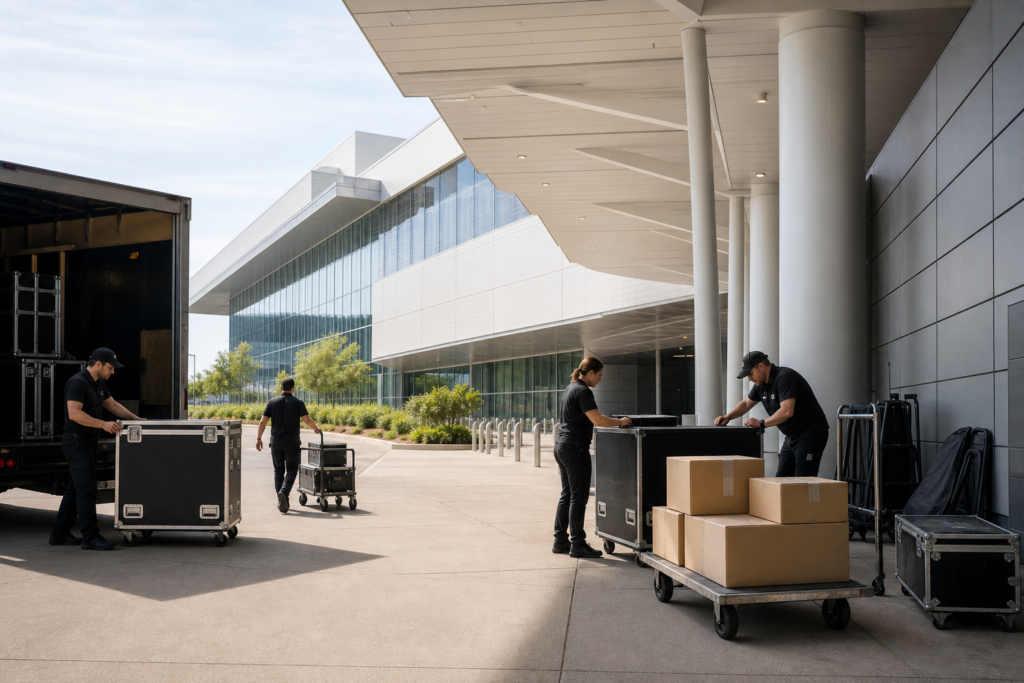
Build transition time into the agenda. Participants may need to find their assigned room, collect materials, move between halls, or ask accessibility questions. If several rooms finish at different times, the plenary debrief can lose momentum, so use synchronized countdowns and a consistent report-out template.
Which roles and materials do breakout rooms need?
Every group should know who is responsible for moving the conversation forward and who is recording the result. In short sessions, one person may hold more than one role, but naming the roles prevents important tasks from being overlooked.
- Facilitator: reads the prompt, manages participation, and protects the objective.
- Scribe: records ideas, decisions, owners, and unresolved questions.
- Timekeeper: gives warnings and ends each stage on schedule.
- Reporter: delivers the agreed summary during the plenary debrief.
A practical physical kit includes a printed prompt, table sign, markers, sticky notes, a timer, and a one-page output sheet. If teams use digital capture, add a clearly labelled QR code or short access instruction, but keep a paper fallback for connectivity or device problems.
Use identical kits in every room. Standardization makes it easier for facilitators to start promptly and gives the event team comparable outputs to consolidate later.
Which room layout is best for each activity?
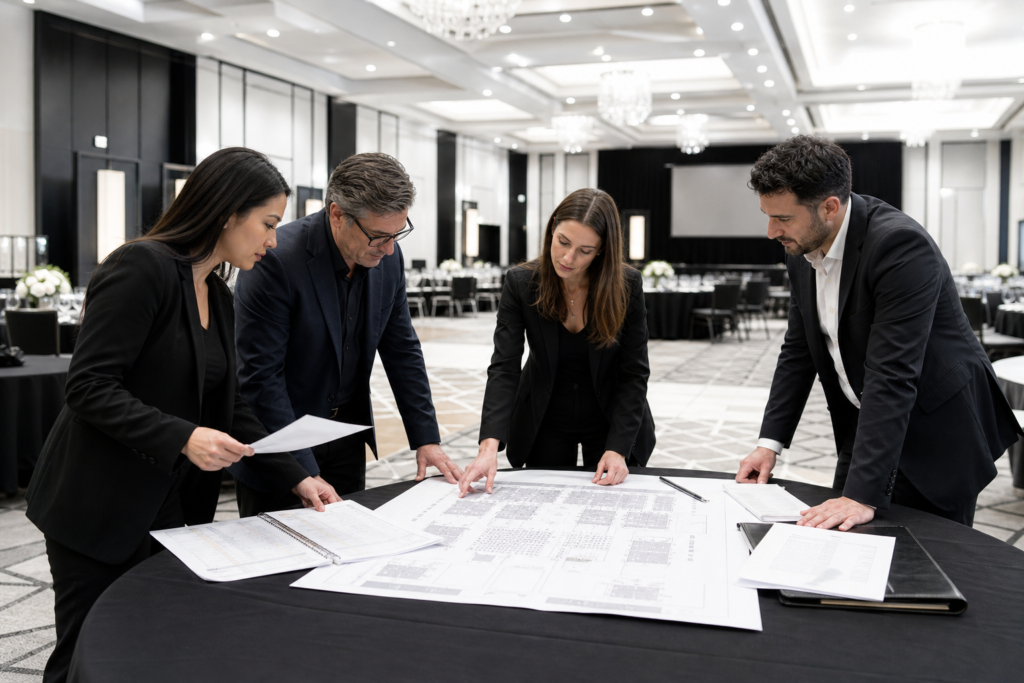
Room layout affects sightlines, movement, noise, and the amount of interaction participants can manage comfortably. Choose a layout based on the task rather than using one arrangement for every session.
- Cabaret or clustered tables: useful for brainstorming, worksheets, gallery walks, and collaborative planning.
- U-shape: useful for demonstrations, training, discussion, and activities where everyone needs to see a presenter.
- Circle: useful for coaching, feedback, peer conversation, and facilitated reflection.
- Standing pods: useful for short, energetic huddles between longer sessions.
Leave enough space for people to enter, exit, and move between stations without interrupting another group. Put the prompt where everyone can see it, position the scribe so the output is visible, and avoid placing screens or boards where they block eye contact.
How can a Mississauga event venue support breakout planning?
A corporate event venue in Mississauga should be assessed for more than its main ballroom. Ask how the venue can support room division, signage, audiovisual consistency, catering flow, storage, accessibility, and transitions between plenary and breakout sessions.
Mississauga Convention Centre has seven halls of approximately 4,250 square feet each, a total capacity of more than 2,200 guests, and 700 on-site parking spaces. The venue is at 75 Derry Road West and serves corporate groups from Mississauga, Toronto, Brampton, and the wider GTA. These business facts can help planners begin a capacity conversation, but the final room assignment should be confirmed against the event’s seating plan, staging, AV requirements, and attendance.
For a practical venue-selection framework, use the corporate event venue decision checklist. Review whether the proposed space allows participants to move quickly, whether each room can receive the same technical support, and whether catering can be positioned without interrupting the work.
Local logistics to consider
GTA attendees may arrive from different directions and may be travelling during busy periods. Build a realistic arrival window before the first breakout, provide clear room numbers, and make the route from registration to each hall easy to follow. If the event takes place in colder weather, plan for coats, boots, and additional arrival or check-in time.
Food and refreshment planning should reflect the actual audience and agenda. The Centre provides in-house catering that spans South Asian, Pakistani Halal, Middle Eastern, Sri Lankan, Caribbean, and Continental cuisines. Confirm dietary requirements, service timing, and the placement of refreshments so breaks do not create congestion at the breakout-room entrances.
What facilitation practices keep breakouts on track?
Read the objective aloud and show the prompt in writing. Explain what the group must deliver, how much time it has, and who will report back. Participants should not have to infer whether the goal is to generate ideas, select one, or create a detailed plan.
Start with silent thinking when the topic is complex or when the audience includes a mix of seniority levels. During discussion, ask the facilitator to invite contributions from people who have not spoken and to separate idea generation from evaluation. A visible timer and warnings at the halfway point, two minutes, and 30 seconds help groups finish rather than drift.
A simple script can make the opening consistent: “Our objective is to choose one improvement we can test. You have four minutes to write ideas, eight minutes to discuss, and five minutes to select one. Record the owner, first step, and date on the output sheet.”
Close every session with a named owner and a next date. “We had a good conversation” is not an output. “Jordan will validate the top assumption with three customers by June 20” is specific enough to support follow-through, provided the team has agreed to that commitment.
How do you measure breakout success?
Measure whether the breakout achieved its intended outcome, not simply whether participants appeared busy. Useful indicators include the percentage of attendees who contributed, the number of completed outputs, the quality of the decisions, and the number of actions that continue after the event.
- Participation: ask facilitators whether most participants contributed at least once.
- Completion: count how many groups submitted a complete output sheet.
- Decision quality: review whether selections include clear criteria and unresolved assumptions.
- Follow-through: check whether owners completed the first action at the agreed review point.
Photograph paper outputs or upload digital boards while the session is still fresh. Organize them by room or topic, then share a concise summary with participants. A scheduled follow-up meeting or message is more useful than promising to “circle back” without an owner.
Corporate breakout room planning checklist
Use this checklist during agenda development and the venue walkthrough:
- Define one measurable outcome for each breakout.
- Choose the activity based on the outcome and available time.
- Set an appropriate group size, usually 4–7 for focused discussion.
- Assign rooms, tables, facilitators, scribes, timekeepers, and reporters.
- Prepare identical materials and a short written prompt.
- Confirm room layouts, sightlines, accessibility, signage, and noise control.
- Test screens, microphones, timers, digital boards, and backup materials.
- Plan movement time, refreshment service, and the return to plenary.
- Use one report-out format so outputs are easy to compare.
- Record an owner, first action, and date before the group leaves.
Frequently asked questions
What is the ideal group size for a corporate breakout room?
Four to seven people is a useful starting point for most focused corporate breakout activities. It gives participants enough perspectives without making it difficult for everyone to contribute. Larger groups can work for gallery walks or World Café rotations, but they should usually be divided into smaller working tables.
How long should a corporate breakout activity run?
Many activities fit within 12–25 minutes, depending on whether the group must only generate ideas or also make a decision. Allow separate time for instructions, thinking, discussion, prioritization, and report-outs. A short activity should have a simpler output than a longer workshop.
How do you stop one person from dominating a breakout?
Begin with silent brainwriting, ask the facilitator to invite contributions in rounds, and use a visible time limit for individual responses. Clear roles and a specific prompt also reduce unstructured debate. If the agenda has multiple cycles, rotate facilitation and reporting responsibilities.
What is the best room layout for brainstorming?
Cabaret or clustered tables usually work well for brainstorming because participants can face one another, write, and share materials. A U-shape is better for training or demonstrations, while a circle supports coaching and reflective discussion. Confirm the final layout with the venue because staging, AV, accessibility, and fire-safety requirements can affect the available arrangement.
Plan your corporate breakout rooms with Mississauga Convention Centre
Effective corporate breakout room ideas depend on alignment between the objective, activity, people, timing, and physical environment. When every group receives a focused prompt and leaves with a visible next step, breakout sessions can make a large corporate event more participatory and more useful.
For help matching your agenda to halls, audiovisual support, staging, and catering, contact Mississauga Convention Centre to discuss your event requirements.