

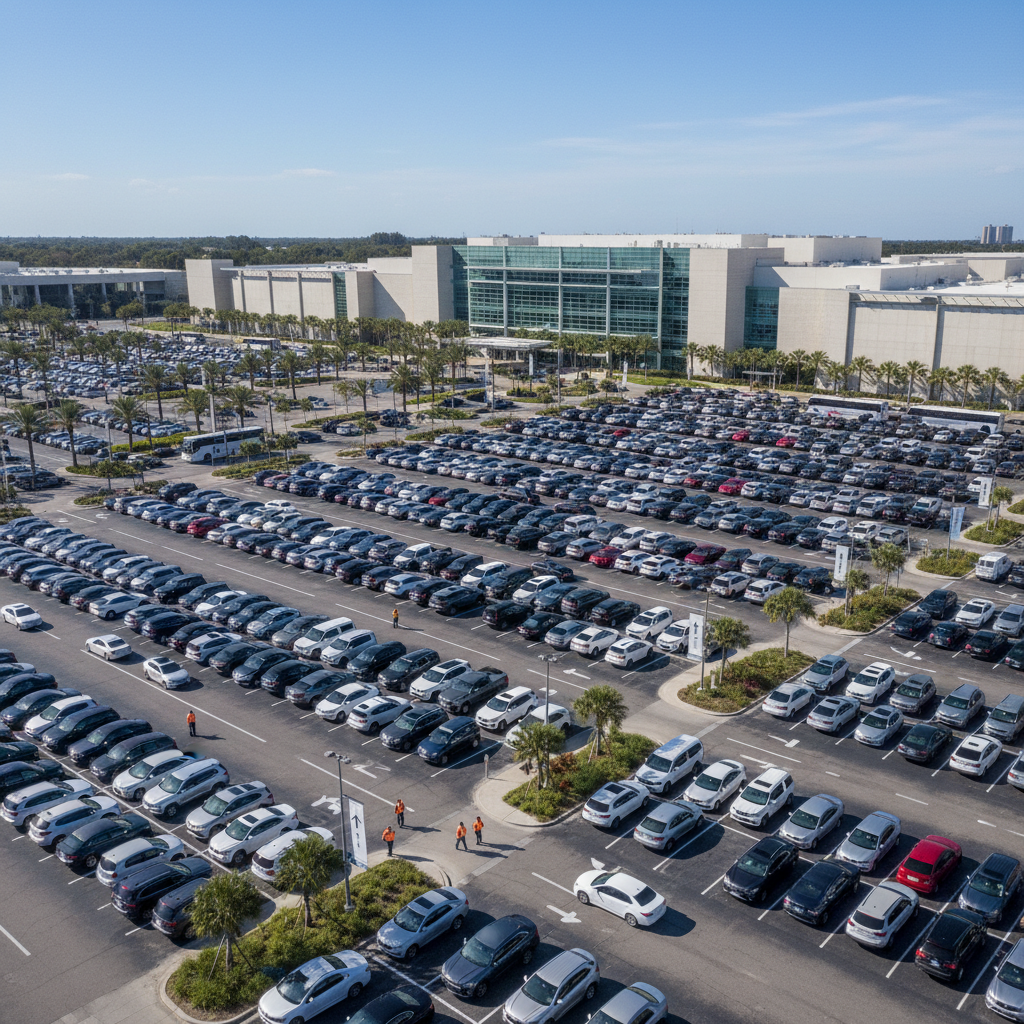
Conference centre parking tips are the practical strategies attendees and planners use to park faster, avoid bottlenecks, and keep sessions on schedule. With 700 on-site spots and seven halls serving up to 2,200 guests in Mississauga, a clear plan saves 10–20 minutes per arrival wave and reduces stress for everyone.
By Preet Dass — Mississauga Convention Centre
Last updated: 2026-04-30
Overview
Conference parking is a choreography problem: move many vehicles into safe, labeled spaces fast. The solution is simple—clear pre-event communication, visible wayfinding, trained attendants, and timed arrival windows. At a venue with 700 on-site spots, small improvements shave minutes per car and protect your run-of-show.
Mississauga Convention Centre hosts conferences, trade shows, galas, school events, and weddings across seven halls (~4,250 sq ft each). That scale demands a plan. We’ve distilled what works across events hosting dozens to 2,200+ guests.
- Primary goal: Reduce friction at peak times (usually 30–45 minutes before registration).
- Key levers: Staggered arrivals, visible signage, staff radios, and a one-page parking map.
- Benchmarks: Attendee exit-to-chair in 12–18 minutes, VIP in 6–10, exhibitors in 15–20.
- Accessibility: Keep accessible parking closest to entrances and unobstructed throughout.
- Contingency: Hold back 10–15% spaces for late surges and service vehicles.

What Is Conference Parking Logistics?
Conference parking logistics is the end-to-end planning of vehicle flow before, during, and after an event. It covers capacity modeling, lane assignments, signage, staff roles, and communications so hundreds of vehicles park safely within 10–20 minutes of arrival windows.
In practice, it’s about designing a predictable sequence: approach, entry, guidance, park, walk, check in. Each step either removes friction or adds it. With seven similarly sized halls, we plan for parallel events by segmenting lanes and holding back capacity for VIPs, accessibility, and service vehicles.
Core components
- Capacity math: Match expected vehicles to available spaces (e.g., 700 on-site), plus 10–15% buffer.
- Segmentation: Separate general, exhibitor/vendor, VIP/accessible, and rideshare to limit cross-traffic.
- Timing: Use 10-minute arrival blocks for registration rushes; 15–20 minutes for exhibition move-in.
- Wayfinding: Large, color-coded arrows and attendants at key decision points speed each car by 20–30 seconds.
- Comms: Send a one-page map, QR link, and arrival tips 72 hours prior; reminder at T–24 hours.
Here’s the thing: you can’t “wing” peak flow. A few upfront decisions prevent jams that can cascade into late starts and missed keynotes.
Why Parking Strategy Matters
Parking is the first on-site impression and a schedule gatekeeper. Smooth flow protects the agenda, reduces late arrivals by double digits, and improves satisfaction scores. For Mississauga events drawing regional drivers, fast parking is often the difference between an energized start and a delayed opening.
We serve corporate teams, schools, social celebrations, and multicultural weddings. Many guests drive in via major highways and the airport corridor. That means peak arrival bursts. A tight parking plan keeps your registration line moving and AV cues on time.
- Experience: Friendly, fast arrivals reduce stress and set the tone for learning or celebration.
- Timing: If 100 cars arrive in 15 minutes, saving 15 seconds per car recovers 25 minutes of collective time.
- Safety: Clear lanes, cones, and trained attendants reduce near-misses during low-light hours.
- Accessibility: Marked and protected accessible spaces ensure all guests can participate fully.
Local considerations for Mississauga
- Plan for weather shifts. In winter, arrivals can slow by 15–25%. Build a larger buffer and brief attendants on snow or rain procedures.
- Expect commuter waves. Morning sessions near the airport corridor may see 7:30–8:30 a.m. surges; aim to pre-open gates by 15 minutes.
- Support multicultural events. Staggered ceremonies or prayer breaks can create mini-peaks; reserve adjacent rows for quick exits.
When stakes are high—product launches, graduations, or headliner keynotes—those first 20 minutes matter more than any other part of the day.
How Parking Works at Mississauga Convention Centre
Our venue offers approximately 700 free on-site parking spaces organized for general guests, VIP/accessible, exhibitors, and service vehicles. With seven halls serving up to 2,200 guests, we use segmented lanes, clearly signed rows, and trained attendants to keep peak arrivals under 15 minutes.
Across corporate meetings, trade shows, school formals, and weddings, the pattern is consistent: predictable arrival waves around registration, move-in, ceremony, or dinner times. We address those waves by segmenting flow and placing attendants at decision points.
Standard arrival flow
- Approach and entry: Cones delineate lanes; attendants direct vehicles to general or VIP/accessible.
- Wayfinding: High-visibility arrows and row markers guide drivers to available clusters quickly.
- Parking: Attendants distribute cars evenly to minimize backtracking and foot traffic conflicts.
- Walk & check-in: Guests follow short, labeled paths to the appropriate hall entrance.
Recommended arrival windows
| Audience | Window | Notes |
|---|---|---|
| General attendees | T–45 to T–15 min | Open two lanes; send T–24 email + SMS reminder. |
| VIP / accessible | T–50 to T–10 min | Dedicated row near entrance; escort if requested. |
| Exhibitors / vendors | T–120 to T–60 min | Unload zone with 10–15 minute dwell limit; then move to parking. |
| Rideshare | T–20 to T+10 min | Marked zone separate from parking aisles. |
| Motorcoaches | T–30 to T+10 min | Pre-assigned drop, staged wait area during program. |
For parallel events, we protect at least one dedicated row per hall and hold 10–15% capacity in reserve for late arrivals, suppliers, and contingencies.
Need a deeper dive into flow design? See our parking logistics guide and our seminar logistics checklist for run-of-show coordination.
Parking Types & Approaches
Use different parking approaches for different needs: general guest parking for most attendees, VIP/accessible rows near entrances, timed exhibitor unloading, and a separate rideshare zone. For large shows, designate off-site overflow with a shuttle only if on-site capacity nears 90%.
General guest parking
- Primary inventory for conferences, galas, school events, and weddings.
- Open two entry lanes during peak 30-minute windows to keep queue length low.
- Use attendants to backfill rows to maintain short walking paths.
VIP and accessible parking
- Protect closest rows to entrances. Do not intermingle with vendor unloading.
- Offer optional escort or wheelchair assistance if requested via registration.
- Keep routes smooth, well-lit, and free of cross-traffic.
Exhibitor and vendor parking
- Designate an unload zone with a 10–15 minute dwell time.
- After unloading, direct vehicles to longer-stay rows away from guest paths.
- For trade shows, maintain a separate service lane for restocking during breaks.
Rideshare and motorcoaches
- Place rideshare pickup/drop-off away from main parking aisles to avoid conflicts.
- For buses, pre-assign drop spots and a staging location during sessions.
- Post-program, meter departures by releasing rows in sequence to prevent gridlock.
Choosing the right approach for each audience segment prevents the classic crunch where exhibitors, VIPs, and general attendees all converge on the same lane at the same time.
Best Practices: 25 Conference Centre Parking Tips
The best conference centre parking tips focus on clarity and timing: publish a one-page map, open two lanes at peak, assign attendants to decision points, and use 10-minute arrival blocks. Protect accessible rows and hold 10–15% of spaces in reserve for surges and service vehicles.
- Send a one-page map 72 hours before doors open; include arrival windows and hall names.
- Use 10-minute blocks for general arrivals; 15–20 minutes for exhibitors.
- Open two entry lanes during the 30-minute peak before registration.
- Staff decision points with attendants where drivers must choose a lane or row.
- Color-code zones on your map so guests can self-route faster at a glance.
- Protect accessible rows near entrances; keep them clear all day.
- Separate vendor unloading from guest aisles; set 10–15 minute dwell limits.
- Meter departures by row at program end to avoid multi-aisle gridlock.
- Pre-brief speakers and VIPs with a reserved route, contact, and time window.
- Use radios or headsets so attendants can re-balance rows in real time.
- Light up paths for dusk or evening events; portable lights improve safety.
- Weather plan: in snow or heavy rain, open an extra lane and add 15–25% buffer time.
- Post signage early—at least 60 minutes before doors—to reduce last‑second confusion.
- Mark rideshare zones away from main aisles; include a short code name on the map.
- Hold 10–15% capacity for late surges, service vehicles, and emergencies.
- Create a group arrivals plan for teams, schools, or wedding parties arriving together.
- Track real-time counts with clickers or a simple tally app; adjust lanes when you hit 70%, 80%, 90% full.
- Brief security on peak timings and escalation protocols.
- Share an SMS keyword for attendees to pull up the parking map on arrival.
- Place water and breaks for attendants every 60–90 minutes during peaks.
- Add a stroller-friendly route for family-heavy events like graduations.
- Plan for ceremonies with multiple entry/exit moments; meter row releases accordingly.
- Use reflective vests and cones so attendants are visible in low light.
- Debrief post-event: record peak timestamps and lane performance for the next show.
- Publish a wheelchair assistance number in pre-event emails and at the entry lane.
For more planning insight, explore our on-site parking articles and broader venue selection checklist.

Tools, Resources & Templates
Plan faster with a one-page parking map, lane assignment matrix, and a pre-event email template. Track live counts with a simple clicker and station radios where lane changes happen. Document what worked so your next event loads even faster.
Planner toolkit
- One-page map: Color-coded lanes, entrances, rideshare, and accessible rows.
- Lane matrix: Who uses which lane at T–120, T–60, T–30, T–15, T–0, T+10.
- Arrival email template: When to arrive, where to enter, what to expect on foot.
- Real-time tally: Clipboards or an app at entry; call out at 70%, 80%, 90% full.
- Radio placements: At entry split, at vendor unload, and at VIP/accessible rows.
- Contingency card: Who to call, how to open a second lane, and where overflow would stage.
For accessibility planning and guest experience, see our venue’s guidance on accessibility requirements. For end-to-end run-of-show, our seminar logistics framework covers registration, AV, and breakout timing.
Curious about how other metro venues handle large flows? Skim regional updates like these convention center notes to understand how urban traffic patterns influence arrival pacing.
Case Studies & Examples
Real events prove the model: segment lanes, publish a map, and time arrivals. Across corporate conferences, trade shows, graduations, and weddings, these moves routinely keep peak arrivals under 15 minutes and shorten walks by distributing cars across the closest rows first.
Corporate summit (600 attendees)
- Challenge: Two back-to-back general sessions; 400 cars arriving 45 minutes pre-show.
- Moves: Opened two entry lanes; 10-minute arrival blocks; VIP row protected.
- Outcome: 12-minute peak arrival time; registration lines cleared by T–5 minutes.
Trade show move-in (150 exhibitors, 1,200 attendees)
- Challenge: Restocking and unload overlapping with attendee arrivals.
- Moves: Separate vendor unload lane with 15-minute dwell; staff radios; rideshare zone moved off main aisle.
- Outcome: Zero lane conflicts; exhibitors parked long-stay rows; attendees reached floor in 14–18 minutes.
School prom (300 students + families)
- Challenge: Family drop-offs creating short-term spikes near doors.
- Moves: Added cones to create a continuous loop; attendants at crosswalks; meter departures by row post-event.
- Outcome: Quick drop-offs; safe pedestrian flow; lot cleared in ~20 minutes after program end.
Multicultural wedding (500 guests)
- Challenge: Multiple ceremony moments produced mini-peaks through the day.
- Moves: Reserved adjacent rows for elders and quick exits; SMS map for late arrivals; umbrellas staged for photos and weather.
- Outcome: Guests parked within 10–15 minutes throughout; easy transitions between ceremony and reception.
If you’re planning parallel hall usage, our corporate venue overview explains how we segment space, catering, and wayfinding to keep experiences distinct even with overlapping schedules.
Frequently Asked Questions
Most parking questions come down to timing, signage, and roles. Open two lanes at peak, protect accessible rows, and give guests a one-page map 72 hours in advance. This simple formula resolves 80% of issues before they start.
When should attendees arrive to avoid lines?
Aim for a 10-minute window starting 30–40 minutes before doors. For keynotes, encourage early birds at T–45. Exhibitors should target T–120 to T–60 for move-in, then relocate vehicles to long-stay rows.
How do you handle accessible parking and drop-off?
We protect clearly marked rows close to entrances and keep them unobstructed all day. If requested during registration, we can coordinate assistance and a nearby drop zone to shorten the walk to hall doors.
What’s the best way to communicate parking details?
Send a one-page parking map and arrival tips 72 hours before the event, with a short reminder 24 hours out. Include a simple code or QR that opens the map on mobile so guests can self-route on approach.
Can you support overlapping events in multiple halls?
Yes. With seven halls and about 700 on-site spaces, we segment lanes, assign rows per hall, and hold 10–15% capacity in reserve. Attendants and signage keep guests moving to the correct entrance without cross-traffic.
Conclusion: Parking Confidence for Every Event
A few disciplined steps—segmented lanes, protected accessible rows, two open lanes at peak, and a one-page map—solve most conference parking problems. With 700 on-site spaces and experienced attendants, Mississauga Convention Centre keeps arrivals smooth for conferences, trade shows, school events, and weddings.
- Key takeaways: Publish the map early, open two lanes, time arrivals, and meter departures.
- Typical results: Peak arrivals under 15 minutes, short walks, and on-time programs.
- Next step: Share your headcount and schedule—we’ll draft a lane and staffing plan.
Ready to plan? Explore our complete parking logistics guide or connect via our corporate event planning page. For weddings and social events, see our wedding venue overview.
Related Guides
If you’re building a broader event plan, our conference logistics checklist details registration pacing and AV cues that tie directly to arrival windows. And if you’re still shortlisting locations, our venue selection guide explains what to inspect on walk-throughs, from parking to power drops.