


 14 October, 2026
 A successful multicultural wedding menu does not try to include every dish from every tradition. It identifies the foods that carry the most meaning, then builds a practical plan around guest needs, service logistics, and the wedding timeline.
Start by separating cultural priorities from flexible preferences, confirm preparation and dietary details directly with the caterer, and choose a service style that suits guest flow. Exact dishes, availability, substitutions, preparation methods, and pricing should always be confirmed for the specific event.
Key Takeaways
- Identify non-negotiable dishes and meaningful traditions while allowing for flexible choices.
- Confirm dietary requirements, including Halal preparation and allergen management, in writing.
- Choose a service style that enhances guest experience and accommodates the flow of the event.
- Map catering logistics against the wedding timeline to ensure seamless service.
- Compare catering proposals using consistent criteria to make informed decisions.
Quick summary

- Identify non-negotiable dishes, meaningful traditions, flexible choices, and impractical options.
- Confirm Halal preparation, vegetarian options, allergens, cross-contact procedures, labeling, and substitutions in writing.
- Choose buffet, plated, stations, family-style service, or passed items based on variety, movement, staffing, and timing.
- Map catering against ceremonies, entrances, speeches, dancing, cake cutting, and room transitions.
- Compare proposals using the same guest count, menu scope, service style, staffing assumptions, fees, and inclusions.
Build the menu around shared priorities
When families have different food traditions, begin with what the meal needs to accomplish rather than asking which cuisine should dominate. A strong plan may need to honor a family recipe, provide familiar choices for older relatives, accommodate Halal or vegetarian guests, and offer variety without making service unmanageable.
Create four lists before speaking with a caterer:
- Non-negotiable dishes: Foods with religious, family, or ceremonial significance.
- Strong preferences: Dishes guests would value but could replace if necessary.
- Flexible choices: Sides, salads, desserts, beverages, or late-night options.
- Practical concerns: Foods that are difficult to serve at scale, lose quality while waiting, or require special equipment.
This framework keeps meaningful dishes central while leaving room for sensible decisions about cost, timing, room layout, and service. For a venue offering in-house catering menus, ask how proposed dishes fit the kitchen operation, service areas, staffing, and schedule.
Ask families the right questions
Cultural planning is more respectful when it avoids assumptions. Invite family members who understand the traditions to explain what matters, then record decisions in a shared planning document.
- Which dishes connect to the ceremony, family history, or a particular region?
- Should certain foods be served after a ceremony or during a family blessing?
- Which dishes should remain traditional, and where is a contemporary interpretation acceptable?
- What spice levels, ingredients, textures, or cooking methods matter?
- Are vegetarian, vegan, Halal, allergy-aware, or alcohol-free choices expected?
- Which foods are essential if the final menu must be shortened?
Avoid choosing one token dish to represent an entire culture. Identify the traditions most important to the couple and families, then add accessible supporting dishes that give guests meaningful choice.
Use cuisine categories as a starting point

Mississauga Convention Centre identifies South Asian, Pakistani Halal, Middle Eastern, Sri Lankan, Caribbean, and Continental cuisine directions. These categories can begin a useful conversation, but they do not confirm specific dishes, preparation processes, certification status, substitutions, or package inclusion.
Ask the caterer to turn each category into a written proposal. “Pakistani Halal,” for example, should lead to questions about exact dishes, ingredients, preparation, kitchen procedures, service format, and labeling. “South Asian” may need to be narrowed by regional preference, vegetarian requirements, spice level, and the role of food within the wedding schedule.
Confirm dietary and preparation requirements
Dietary planning should happen before the menu is finalized. Do not rely on a label alone. Ask what it means for this event and how the caterer will prevent confusion during preparation and service.
- Halal: Ask how ingredients and preparation are handled, whether certification or documentation applies, and whether separate utensils, equipment, storage, or service procedures are used.
- Vegetarian and vegan: Confirm stocks, sauces, dairy, eggs, garnishes, and how suitable dishes will be identified.
- Allergies: Provide a written list of serious allergies and ask about ingredients, substitutions, labeling, and cross-contact procedures.
- Communication: Decide whether menu information will appear on signs, place cards, buffet labels, or through servers.
- Substitutions: Confirm whether individual meals or replacement dishes are possible and when requests are due.
Ontario Regulation 493/17 includes requirements applicable to food premises and provisions concerning special-event meals. Review the applicable Ontario food-premises regulation for official wording, but use event-specific discussions with the venue or caterer to confirm the actual plan.
Choose a service style that fits the experience
Service format affects presentation, variety, queue length, staffing, room layout, and the time available for wedding moments.
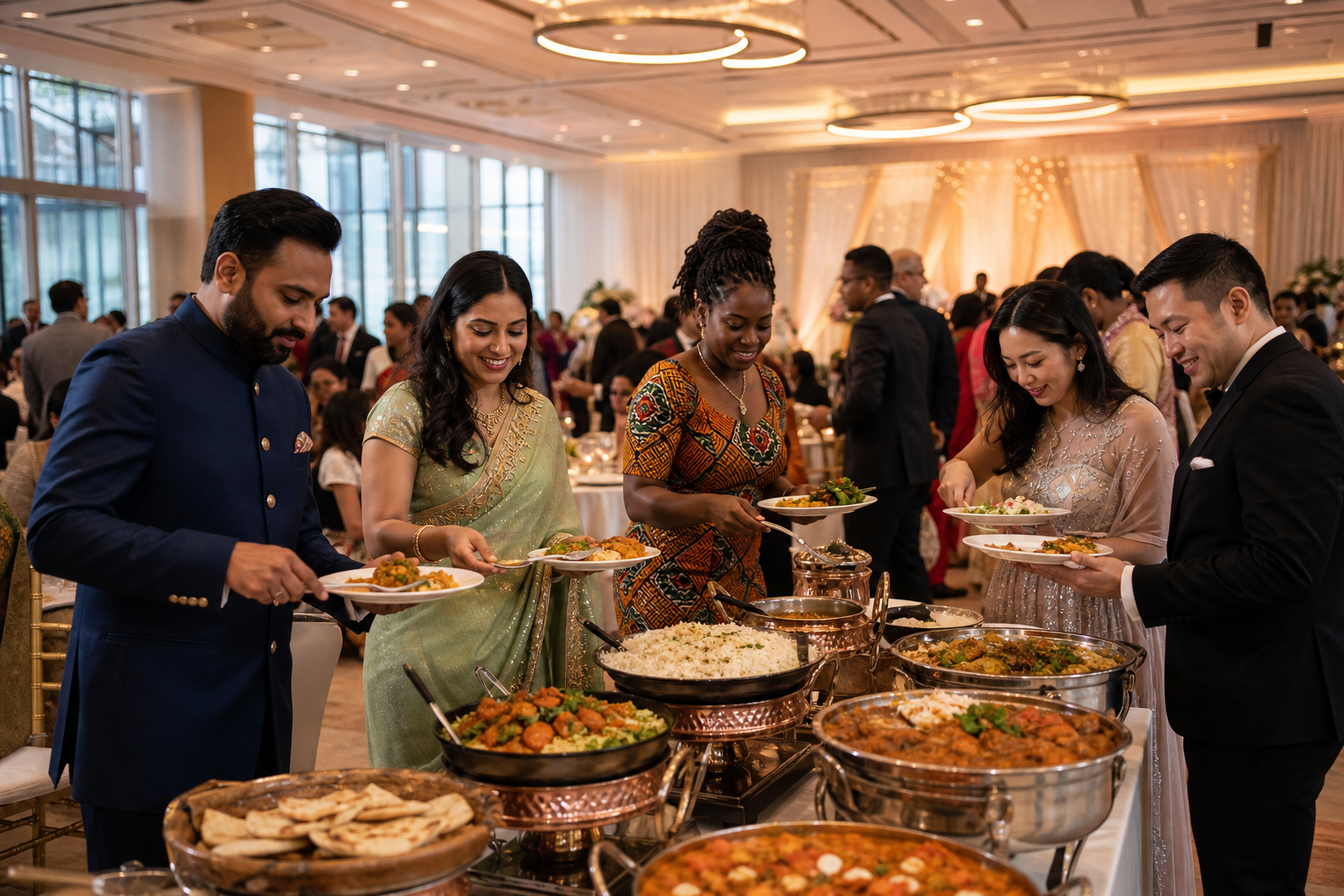
Buffet service can work well when guests value choice and the menu includes several cultural directions. It requires careful queue planning, replenishment, labeling, and enough time for every table to reach the stations. Plated service creates a controlled pace and formal presentation, but it offers less spontaneous choice and requires accurate meal counts.
Food stations can separate menu themes and encourage guest choice, but they need space and may create movement during speeches or performances. Family-style service supports sharing and conversation, while passed items work well during cocktail periods and transitions. Each format has to be assessed against the venue, menu, guest count, and run of show.
Buffet, plated, or stations: a practical comparison
| Service style | Best suited to | Key questions |
|---|---|---|
| Buffet | Menus with variety and differing preferences | How will queues, labels, dietary dishes, replenishment, and table release work? |
| Plated | Formal receptions with a structured schedule | When are selections due, and how are allergies and substitutions tracked? |
| Food stations | Interactive receptions or distinct cuisine themes | How much space, staffing, power, and service time do stations require? |
| Family-style | Celebrations centered on shared food | How will portions, dietary separation, table space, and replenishment work? |
| Passed items | Cocktail hours and transitions | How many rounds are planned, and how are dietary options identified? |
Coordinate food with ceremonies and dancing
Build catering into the run of show. Note guest arrival, ceremonies, room changes, entrances, speeches, dancing, dessert, cake cutting, and the final service window. A buffet opened during a major entrance can divide guests’ attention, while a meal that begins too late can compress the reception.
Confirm cocktail service, meal release by table, clearing time, coffee or tea, late-night food, and transitions between indoor and outdoor spaces. If the celebration includes several functions, plan each one separately rather than treating the entire wedding as one catering order.
Plan for multiple wedding functions
Mississauga Convention Centre’s Gujarati wedding information describes celebrations such as mehndi, garba, ceremonies, receptions, chandlo matli, gol dhana, and grah shanti. This example shows why each function may need its own guest count, menu direction, service style, room setup, and timing.
Ask the venue to confirm what can be accommodated on the selected dates and whether separate proposals, setups, teardowns, or staffing plans are required. Do not assume that one schedule or menu fits every cultural wedding.
Make the menu work with the venue
Room size, buffet placement, stage sightlines, dance-floor space, technical equipment, lighting, and service access can all affect the meal. A layout that works for a reception may be awkward when the same room must also accommodate a ceremony or cultural performance.
Mississauga Convention Centre describes seven halls of approximately 4,250 square feet each, total capacity above 2,200 guests, about 700 on-site parking spaces, in-house audiovisual systems, lighting, staging, technical support, and an outdoor patio option. Treat these as planning considerations and confirm which room, services, and transitions suit the specific event.
Compare proposals using the same assumptions
Comparing only food prices can be misleading. One proposal may include staffing, beverages, room use, setup, or technical support that another lists separately. Use the same estimated attendance, menu scope, service style, event duration, and required services for every proposal.
Review the catering quote factors that can change the total, including guest count, menu complexity, staffing, service style, schedule, venue services, enhancements, and contract charges. Mississauga Convention Centre states that quotes are tailored to event type, size, menu, and selected enhancements, so event-specific pricing must be confirmed.
Catering quote factors to review
| Factor | Confirm in writing |
|---|---|
| Guest count | Estimated count, guaranteed count, and final-count deadline |
| Menu scope | Exact dishes, portions, substitutions, tastings, and beverages |
| Dietary needs | Halal, vegetarian, vegan, allergy, and cross-contact handling |
| Service style | Sequence, staffing, replenishment, clearing, and timing |
| Venue services | Room rental, AV, lighting, staging, décor, setup, and enhancements |
| Contract charges | Taxes, service charges, minimums, deposits, deadlines, and cancellation terms |
Final multicultural wedding catering checklist
- Identify genuinely non-negotiable dishes and traditions.
- Confirm exact dishes, ingredients, portions, spice levels, and substitutions.
- Verify Halal procedures, vegetarian and vegan choices, allergy handling, labeling, and cross-contact precautions.
- Match service style to guest count, layout, accessibility needs, and schedule.
- Include ceremonies, speeches, dancing, cake cutting, dessert, and late-night food in the run of show.
- Give every wedding function its own menu, guest count, room plan, and timing.
- Ask about tastings, staffing, setup, teardown, and event-day contacts.
- Confirm every inclusion, enhancement, fee, deadline, and cancellation term.
- Ensure the families and caterer share the same final menu and timeline in writing.
Frequently asked questions
How do you combine two or more cultural cuisines at one wedding?
Start with the dishes carrying the greatest cultural or family significance, then add flexible choices that balance the meal. Buffet service, stations, or family-style service may provide variety without making the menu too crowded.
What should couples ask about Pakistani Halal wedding catering?
Ask which dishes are available, how ingredients and preparation are handled, whether certification or documentation applies, how utensils and service areas are managed, and how the menu will be labeled.
Is buffet or plated service better for a multicultural wedding?
Buffet service generally offers more choice, while plated service provides a controlled pace and formal presentation. The right choice depends on the menu, guest count, layout, staffing, dietary needs, and schedule.
How should allergy concerns be confirmed?
Give the caterer a written list of serious allergies and ask about ingredients, preparation, utensils, labeling, substitutions, and service. Include the agreed process in the final proposal.
Can multiple cultural wedding functions use different menus?
Yes, they may need different menus and service plans because a ceremony, mehndi, reception, or family gathering can have different guest counts and pacing. Treat each function as a separate brief and confirm availability with the venue.
Choose a catering plan that honors the occasion
The strongest multicultural wedding menu is not necessarily the longest. It preserves meaningful traditions, gives guests clear choices, fits the room and schedule, and can be delivered according to confirmed preparation and service standards.
Prioritize the dishes that matter most, verify dietary details, choose service around guest flow, and compare complete proposals rather than headline prices. To discuss your event brief, wedding functions, menu direction, and catering needs, contact Mississauga Convention Centre.