 20 October, 2026
The right staging and lighting rig depends on what guests must see, hear, and experience, not on how much equipment fits in the room. A presentation may need a clear front wash and screen-conscious lighting, while a gala, wedding, or live performance may also need backlighting, uplighting, focused effects, and timed cues.
Start with the event program, guest count, room layout, stage plan, and visual priorities. Then confirm ceiling conditions, rigging permissions, available power, cable routes, access windows, and technical responsibilities with the venue or a qualified production supplier.
What a Staging and Lighting Rig Includes
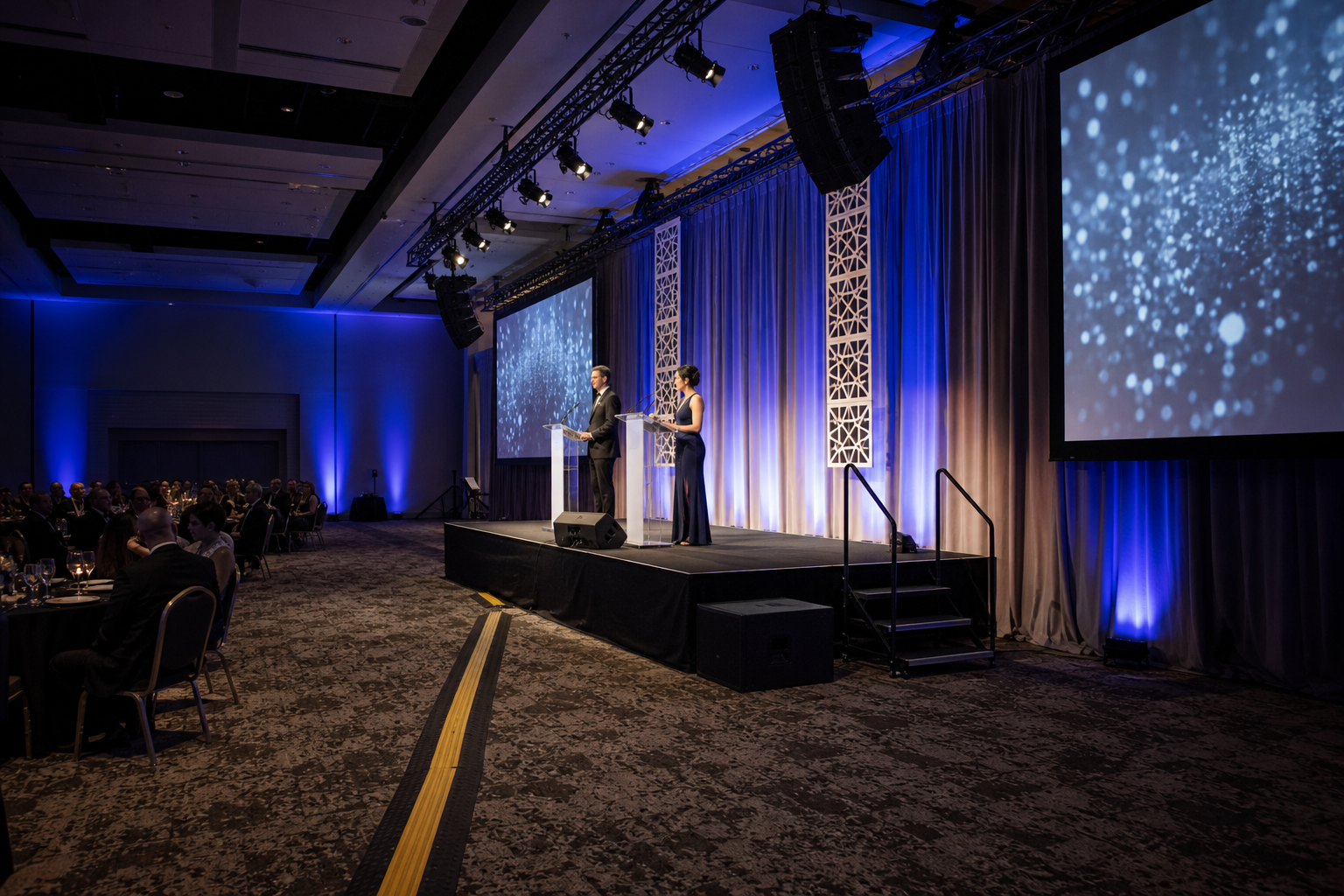
A staging and lighting rig is the coordinated system that supports the event platform, illuminates people and spaces, manages visual transitions, and keeps production under control. It may include a stage, steps, lectern, backdrop, lighting fixtures, control equipment, power distribution, cabling, safety equipment, and operators.
- Fixtures: Front wash, backlight, focused fixtures, pin spots, uplights, or moving fixtures selected for the event’s purpose.
- Control: A lighting control system, cue list, operator position, and communication method for rehearsals and live changes.
- Power and distribution: Suitable circuits, connectors, distribution equipment, and protected routes confirmed on site.
- Cabling and safety: Approved cable protection, fixture restraints, secondary safety attachments, and clear guest and worker paths.
- People and process: Technical personnel, a stage manager or show caller, and a documented production schedule.
Responsibility may be divided between the venue, an outside production company, the event planner, and the client. Do not assume that general AV, lighting, or staging support includes every fixture, operator, rigging device, or installation method. Confirm the scope line by line.
For a broader view of equipment, power, signal flow, and venue constraints, review this conference AV setup guide, which also covers stage lighting and rigging points.
Choose the Right Lighting Approach

Think of the lighting plan in layers. First solve visibility. Then add separation, atmosphere, branding, or movement only when it supports the program.
Stage wash
A front wash provides consistent light across presenters, speakers, or a ceremony area. It is the starting point for conferences, seminars, school events, panel discussions, and award presentations. It should illuminate faces without creating screen glare or harsh shadows.
Backlighting
Backlighting helps speakers, performers, or a couple stand out from a backdrop. It adds depth to photographs and video, but must be aimed so it does not shine into the audience, cameras, or screens.
Uplighting
Uplighting adds colour or soft illumination to walls, drapery, architectural features, or scenic elements. It can support a corporate palette, wedding theme, gala mood, or school colours. It should not replace lighting for people on stage.
Focused lighting
Pin spots or focused fixtures draw attention to a lectern, award position, cake, head table, product, display, or performance area. They require accurate aiming and cue planning to avoid glare or distracting shadows.
Fuller production rigs
A more involved rig may suit live entertainment, theatrical performances, award programs, product launches, or events moving between ceremony, dinner, dancing, and presentations. Greater complexity brings more equipment, setup time, operator decisions, power planning, and safety review. It should be justified by the program.
For celebrations, this overview of AV and lighting, stage wash, and programmable uplighting explains how visibility, atmosphere, and event flow work together.
Lighting Options Compared
| Lighting type | Best use | Benefit | Tradeoff |
|---|---|---|---|
| Front wash | Speeches, panels, ceremonies | Even visibility | Can create glare or a flat look |
| Backlight | Performances, ceremonies, photography | Adds depth and separation | Needs careful aiming |
| Uplighting | Weddings, galas, receptions | Creates atmosphere | Does not light faces adequately |
| Pin spots | Cake, awards, products, décor | Directs attention | Requires accurate focus |
| Moving lights | Entertainment and transitions | Provides movement and colour changes | Increases programming and safety requirements |
| Screen-conscious lighting | Conferences and recorded events | Protects slide readability | Requires video coordination |
The best plan often combines two or three categories. A conference may use front wash, restrained backlight, and screen-conscious dimming. A wedding may use stage wash for speeches, uplighting for the reception, and pin spots for the cake or head table.
Venue Conditions That Shape the Design
A lighting design cannot be approved from a mood board alone. The room determines where equipment can go, how much light is needed, how guests move, and whether a support method is possible.
- Room size and configuration: Long rooms, divided halls, ballrooms, and exhibition areas may need different fixture positions and control zones.
- Ceiling height and rigging points: Ask whether overhead suspension is permitted, where approved points are located, what documentation is required, and whether ground-supported alternatives are preferred. Never infer a load rating.
- Ambient light: Windows, doors, chandeliers, and reflective surfaces affect contrast and camera exposure.
- Power: Confirm circuits, distribution, connection points, and whether lighting shares power with audio, video, catering, or exhibits.
- Sightlines: Fixtures, truss, scenic pieces, speakers, and screens must not block guests, cameras, presenters, or emergency routes.
- Access and cabling: Schedule load-in, setup, focus, testing, rehearsal, guest entry, and teardown. Plan cable routes around doors, aisles, registration, food service, and stage access.
Mississauga Convention Centre offers seven halls of approximately 4,250 square feet each, with total capacity of more than 2,200 guests. That combined figure is not the capacity of one room. Request a layout showing the stage, tables, screens, lighting positions, circulation paths, and exhibition or dining areas.
The venue documents professional audiovisual systems, lighting, staging, and technical support for corporate meetings, conferences, trade shows, weddings, galas, social events, and school events. Specific equipment, rigging permissions, power arrangements, and inclusions still need confirmation for the selected hall.
Coordinate Lighting With the Event Program
Lighting should follow the run of show. Create a cue sheet identifying what changes, when it changes, who calls the cue, and what happens if a cue is delayed. Share the current schedule with the lighting operator, stage manager, AV operator, emcee, and venue team.
- Arrival: Provide comfortable general lighting for registration and wayfinding.
- Presentations: Keep faces evenly lit while reducing light near screens. Test from the back and sides of the audience.
- Awards: Light the presenter, recipient position, walk-on route, and photo area.
- Meals: Maintain comfortable room light for dining and conversation while avoiding aggressive effects.
- Performances: Add programmed changes only when they support the act and do not interfere with cameras, screens, or guest comfort.
- Weddings: Plan separate looks for the ceremony, entrance, speeches, first dance, dinner, and reception.
Schedule a technical rehearsal for entrances, awards, videos, performances, first dances, and room transitions. Use it to check screen glare, camera exposure, microphone positions, stage access, and operator communication.
Prepare a Pre-Booking Technical Brief
Send a concise brief before requesting a final proposal. Include:
- Event type, date, location, attendance, and room requirements.
- Stage dimensions, lectern, backdrop, dance floor, head table, product area, or exhibit footprint.
- Program schedule, speakers, performances, awards, meals, ceremonies, and transitions.
- Lighting goals for visibility, branding, photography, video, streaming, and decorative effects.
- Screen, camera, speaker, and control positions, with sightlines marked on the floor plan.
- Ceiling height, approved rigging points, ground-support options, load documentation, and approval requirements.
- Power, cable routes, floor protection, emergency routes, load-in, rehearsal, and teardown windows.
- Responsibilities for equipment, operators, rigging, electrical work, inspections, cue calling, and cable management.
- Included services, optional enhancements, staffing, storage, insurance, deposits, taxes, and cancellation terms.
Ask for a marked floor plan and a written list of exclusions. A proposal that says lighting is included may still leave fixture types, operator hours, rigging, programming, rehearsal, or teardown undefined.
Staging and Lighting Rig Safety Checklist
Technical work must be handled by appropriately qualified people and approved by the venue. Ontario’s live-performance safety guidance recommends effective bonding for metal structures used to support lighting or power distribution and secondary restraints such as safety chains or safety cables for fixtures and accessories. Review the Ontario electrical safety guidance.
- Obtain venue approval for the stage, support structure, overhead work, power plan, and cable routes.
- Use qualified personnel for rigging, electrical connections, fixture installation, and inspections where required.
- Confirm bonded metal structures and suitable secondary restraints.
- Protect cables across floors and keep aisles, exits, stairs, and emergency routes clear.
- Inspect fixtures, clamps, connectors, stands, cables, and supports before guests enter.
- Provide running lights in backstage or dark work areas. Review the Ontario working-in-the-dark guidance.
- Document who can stop setup, approve changes, respond to faults, and authorize re-entry after an adjustment.
This is general planning information, not a replacement for a venue review, risk assessment, qualified rigger, electrician, engineer, or other required professional. Never improvise an overhead installation.
How to Review a Venue or Production Proposal
Compare proposals using the same event brief. A lower price may exclude operators, setup hours, staging, screens, programming, rehearsal, power distribution, or teardown. Confirm:
- Which fixtures, control equipment, support structures, cables, restraints, screens, and accessories are included.
- Who designs, installs, focuses, operates, calls cues, supervises rigging, and manages changes.
- How much time is included for load-in, focus, rehearsal, guest entry, and teardown.
- What has been confirmed about ceiling height, rigging points, power, ambient light, floor protection, and access.
- How the run of show, cue sheet, screen plan, camera plan, and meal schedule will be coordinated.
- What overtime, changes, additional staffing, specialized equipment, taxes, deposits, and cancellation charges apply.
Frequently Asked Questions
Does every event need a full staging and lighting rig?
No. A small meeting may need only a lectern and basic stage lighting. Conferences may add screen-conscious wash, while galas, weddings, and performances may need uplighting, backlight, focused fixtures, and programmed cues.
What should I ask about overhead rigging points?
Ask whether overhead rigging is permitted, which points are approved, what load information and documentation are available, who may install equipment, what insurance or review is required, and whether ground-supported alternatives are available.
How early should I provide a lighting plan?
Provide the initial brief as soon as you know the room, attendance, stage concept, screen plan, and program format. Rigging questions, power needs, access windows, equipment availability, and approvals should not wait until event week.
Can uplighting replace stage lighting?
Usually not. Uplighting is primarily decorative. Presenters need controlled light on their faces and work areas, while screens need protection from glare.
Conclusion: Match the Rig to the Room and the Program
A dependable plan starts with three questions: what must be visible, what moments need a cue, and what can the venue safely support? Begin with stage wash and screen-conscious lighting when clarity is the priority. Add backlight, uplighting, pin spots, or moving effects only when they serve a specific program need.
Before booking, send a technical brief covering attendance, room, stage, screens, power, rigging, cable routes, access, rehearsal, operators, and safety responsibilities. Then review the proposal line by line with the venue and qualified technical personnel.
To discuss your event format, attendance, room, staging concept, lighting needs, access schedule, and safety requirements, contact Mississauga Convention Centre.