

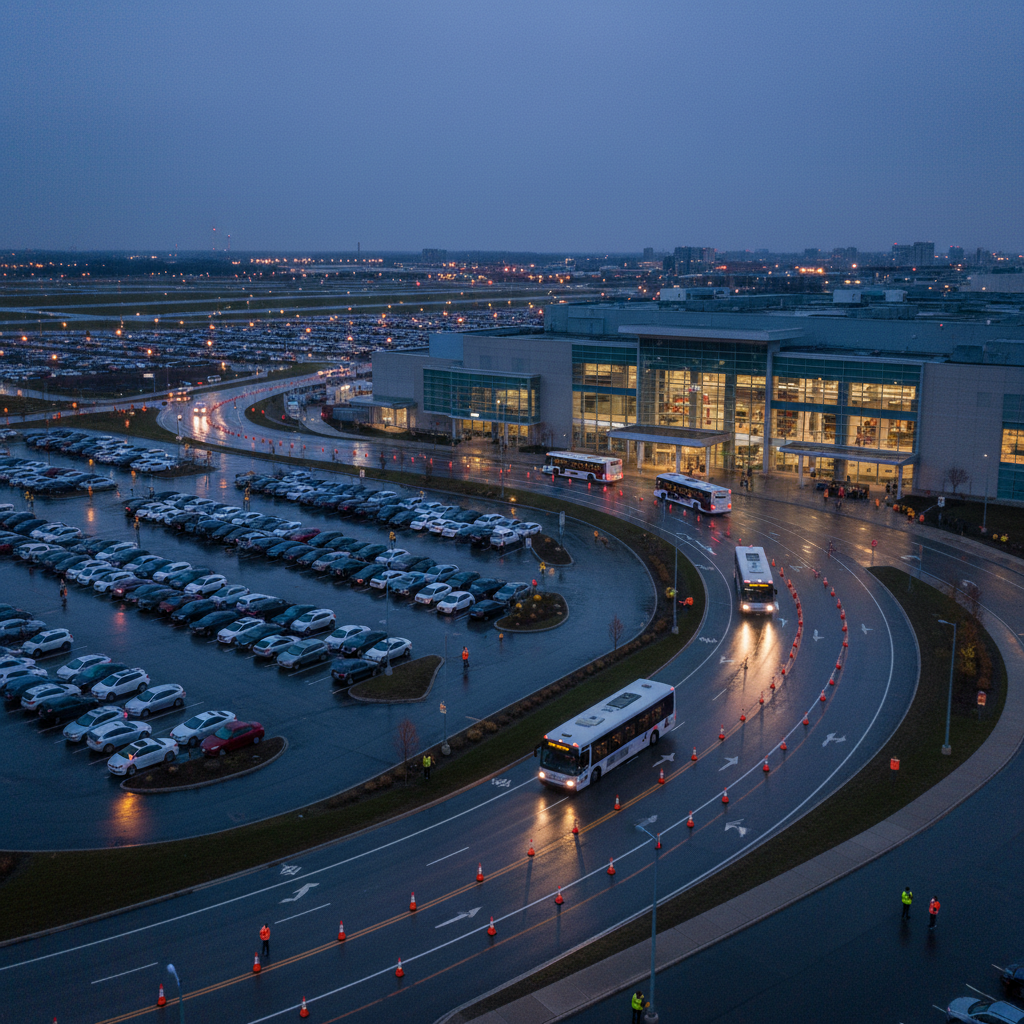
 20 September, 2026
Last updated: October 2026
What event parking logistics management includes
Event parking logistics management covers the complete vehicle journey, from the first arrival instruction to the final car leaving the site. It is broader than marking spaces or placing a few directional signs. A useful plan connects the guest list, event schedule, venue access points, parking supply, traffic conditions, pedestrian routes, staff responsibilities, and contingency actions.
At Mississauga Convention Centre, 75 Derry Road West, planners can work with seven halls of approximately 4,250 square feet each, capacity for more than 2,200 guests, and 700 on-site parking spaces. Those confirmed venue facts provide a strong starting point, but they do not remove the need to study the event schedule. A conference with several arrival waves, a wedding with concentrated family arrivals, and a trade show with early exhibitor vehicles will place different demands on the same property.
The plan should answer six operational questions before event day:
- How many vehicles are likely to arrive, and when will they arrive?
- Which guests, suppliers, or vehicles need priority access?
- Where will general parking, accessible parking, passenger drop-off, rideshare, and loading activity occur?
- Which entry, exit, crossing, or turning points require staff?
- What happens if a zone fills, weather changes, a vehicle breaks down, or a road incident affects arrivals?
- How will the team measure whether ingress and egress worked?
For planners comparing an event venue in Mississauga for a corporate programme, parking should be reviewed at the same time as room layouts, registration, loading access, and guest communications. A venue may have adequate total capacity but still create friction if the closest spaces are blocked by suppliers, the pedestrian route is unclear, or several audiences arrive through one unmanaged curb.
Match parking decisions to the event type
Corporate conferences often produce a predictable opening surge, followed by smaller waves for breakout sessions. A trade show may require exhibitor vehicles and freight movement before doors open. Weddings, galas, and cultural celebrations can create more concentrated arrivals, passenger drop-offs, and requests for close-in parking for older guests or people with mobility needs.
School proms and graduations require a different distinction between drop-off and self-parking. A one-way passenger loop can keep vehicles moving while marshals protect the walking route to the entrance. The important point is not to copy a generic parking layout: build the operation around the audiences, schedule, and access needs of the specific event.
How to forecast capacity and zone the site
Capacity planning starts with people, not spaces. Registration totals rarely equal vehicle totals because guests may carpool, use taxis or rideshare, arrive by shuttle, share a household vehicle, or attend only part of a programme. The planner should estimate vehicle demand by audience and arrival period, then compare the estimate with usable capacity rather than relying only on a headline parking count.
Build an arrival-demand estimate
Begin with the confirmed or expected attendance. Divide the audience into practical groups such as employees, guests, exhibitors, speakers, suppliers, wedding party members, and accessible-transport users. For each group, estimate the likely travel mode and arrival window. A corporate event with a published staggered registration schedule should be modelled differently from a reception where many guests arrive shortly before the start time.
Use a range rather than a single false-precision number. A low-demand estimate supports the ordinary plan; a high-demand estimate tests whether an overflow trigger, remote parking, shuttle, or revised arrival instruction is needed. If the high estimate cannot be accommodated, solve the issue before invitations or event reminders are finalized.
Also account for vehicles that occupy space without representing attendees. Catering vehicles, audiovisual suppliers, decorators, security vehicles, accessible transport, and exhibitor vans may need a timed location. Protecting those spaces in the general parking count can prevent a last-minute conflict at the entrance.
Create zones with clear priorities
A zone map should be simple enough for a guest to understand on a phone and detailed enough for a supervisor to operate. Common zones include:
- Accessible parking: Located as close as possible to an accessible entrance, with a safe route and sufficient access aisles.
- Passenger drop-off: A clearly marked area where a passenger can leave a vehicle safely without blocking through traffic.
- VIP and speaker parking: A controlled area for people whose arrival time or proximity matters to the programme.
- General parking: The largest zone, supported by visible numbering, lettering, colour cues, or landmarks.
- Exhibitor and supplier access: A timed area that keeps loading and unloading separate from guest arrival whenever possible.
- Rideshare and taxi activity: A separate pick-up or drop-off point that does not compete with the main pedestrian crossing.
Do not designate a zone without also defining who opens it, who checks it, what sign identifies it, and what happens when it reaches practical capacity. A zone that is technically available but poorly marked or difficult to reach is not reliable operating capacity.
Plan the walking experience
Drivers become pedestrians as soon as they leave their vehicles. Walk the route from the farthest practical space to registration or the main entrance. Note crossing points, changes in surface, lighting, snow or water accumulation, construction, narrow passages, and places where a guest might naturally take a shortcut through moving traffic.
Use signs to answer the next question a guest has: where to park, where to walk, where to drop off, or where to collect a vehicle later. Repeating a sign at decision points is generally more useful than placing one large sign at the property entrance and leaving guests to interpret the rest.

How to design traffic flow and arrival routes
Traffic flow should make the correct movement the easiest movement. Draw the route from the public road to the parking zone, then from the parking zone to the exit. Mark every point where a driver could hesitate, cross another stream, turn against the intended direction, or stop to ask a question. Those are the places that need a sign, a physical control, a trained attendant, or a change to the layout.
Separate competing movements
The most common conflicts involve general arrivals, passenger drop-offs, rideshare vehicles, exhibitors, and pedestrians competing for the same curb. Separate these movements spatially or by time. For example, schedule exhibitor load-in before general doors open, give suppliers a named contact and arrival window, and keep passenger drop-off moving rather than allowing vehicles to wait beside the entrance.
Use one-way loops where the site permits them, and avoid asking drivers to reverse direction in a crowded curb area. If two flows must intersect, place a marshal at the crossing and give that person authority to pause one movement. A cone line without a responsible operator may be ignored or moved as conditions change.
Coordinate roads, closures, and arrival information
Events that affect a public road may require advance coordination beyond the venue property. Peel Region states that special-event road-closure applications must be submitted at least 60 days before the event, and that police traffic control and a traffic management plan may be required depending on the location and scale. Confirm the current requirements with the responsible authority rather than assuming an internal parking map covers public-road activity.
Mississauga’s outdoor community-event process may involve the City’s Special Events Advisory Team and external partners such as fire, police, and security for larger or more complex events. If the event involves road closures, full-site use, or unusual traffic conditions, begin that conversation early. Do not advertise a closure until the required application and approvals are in place.
For routes approaching the venue from major corridors, monitor official travel information before staff briefing and again during the event. Ontario’s incidents and closures data supports awareness of active provincially maintained highway conditions, while the province’s highway corridor management guidance explains that closures are not permitted on active freeways and other listed highway corridors. These sources help planners communicate responsibly; they are not a substitute for an approved traffic plan.
Include an arrival message that is useful without encouraging unsafe manoeuvres. Give the venue address, the recommended entrance, the parking or drop-off instruction, the approximate walking route, and a warning that traffic conditions may change. Never ask guests to stop on a highway shoulder, make an illegal turn, or use an unapproved roadside area.
Use a timed operations sequence
| Timing | Operational focus | Checks |
|---|---|---|
| Several weeks before | Design and approvals | Confirm attendance pattern, zones, suppliers, access needs, and any municipal or regional requirements. |
| One week before | Prepare the team | Finalize the map, staff roster, radio plan, signs, weather response, and escalation contacts. |
| Two hours before | Set the site | Place signs and cones, inspect paths, confirm lighting, reserve priority areas, and brief every role. |
| During ingress | Balance and protect | Watch queues, keep crossings safe, redirect full zones, and record incidents or recurring questions. |
| During the programme | Maintain readiness | Keep a reduced team available for late arrivals, deliveries, accessibility requests, and weather changes. |
| At egress | Release vehicles safely | Protect pedestrians, manage pick-up points, prevent opposing flows, and keep staff in place until demand falls. |
Accessibility, safety, and local coordination
Accessible parking is part of the arrival route, not an isolated space count. Ontario’s guide to accessible events recommends placing accessible spaces as close as possible to accessible venue entrances and exits, lifts, ramps, and pay stations. It also recommends a clearly marked passenger drop-off area close to the event entrance.
Review the entire accessible path: the space, access aisle, surface, curb transition, crossing, entrance, and interior route. The Ontario guidance on accessible public spaces notes that physical constraints may affect what can be provided, but spaces should be clearly marked and include access aisles wide enough for people to enter and leave vehicles. Assign a staff member who can answer questions and address obstructions respectfully.
For a larger outdoor or complex event, the City of Mississauga’s outdoor community-event permit information can help organizers understand when additional review may apply. The supplied municipal special-event requirements also emphasize visible accessible parking signs, accessible paths, and accommodation for visitors with disabilities. Treat these as planning inputs and verify the current requirements for the specific event.
Control vehicle and pedestrian risk
Keep pedestrians and moving vehicles apart wherever possible. Use protected walking channels, staffed crossings, barriers where appropriate, and a lower-speed operating environment. Attendants should use consistent signals, wear visible identification, and avoid standing where they cannot be seen by both drivers and pedestrians.
A written traffic protection plan is especially important where temporary works, construction, delivery activity, or unusual hazards exist. Ontario’s construction-site guidance distinguishes a traffic control plan for driver safety from a traffic protection plan for worker protection. The relevant plan should identify hazards, controls, detours, protective clothing, and inspection of traffic-control devices when those conditions apply.
Inspect signs and equipment throughout the event. Wind can move lightweight signs, rain can reduce visibility, and snow or ice can change stopping distances and walking routes. Arrange removal or treatment of hazards through the responsible venue or site team, and give staff a clear way to report a blocked aisle, damaged sign, spill, collision, or medical concern.
Prepare a practical incident response
The parking lead should have a short response card rather than relying on memory. It should state who receives the first radio call, who contacts emergency services when required, who protects the scene, who redirects vehicles, and who communicates with venue management. Staff should not attempt to manage a serious injury, fire, collision, or security issue beyond their training.
For a stalled vehicle, protect the lane, move traffic only when safe, and notify the lead. For a full zone, stop sending vehicles into it and activate the pre-briefed alternative. For a sudden road incident, update the arrival message through the event team and avoid improvised directions that could create a new hazard.
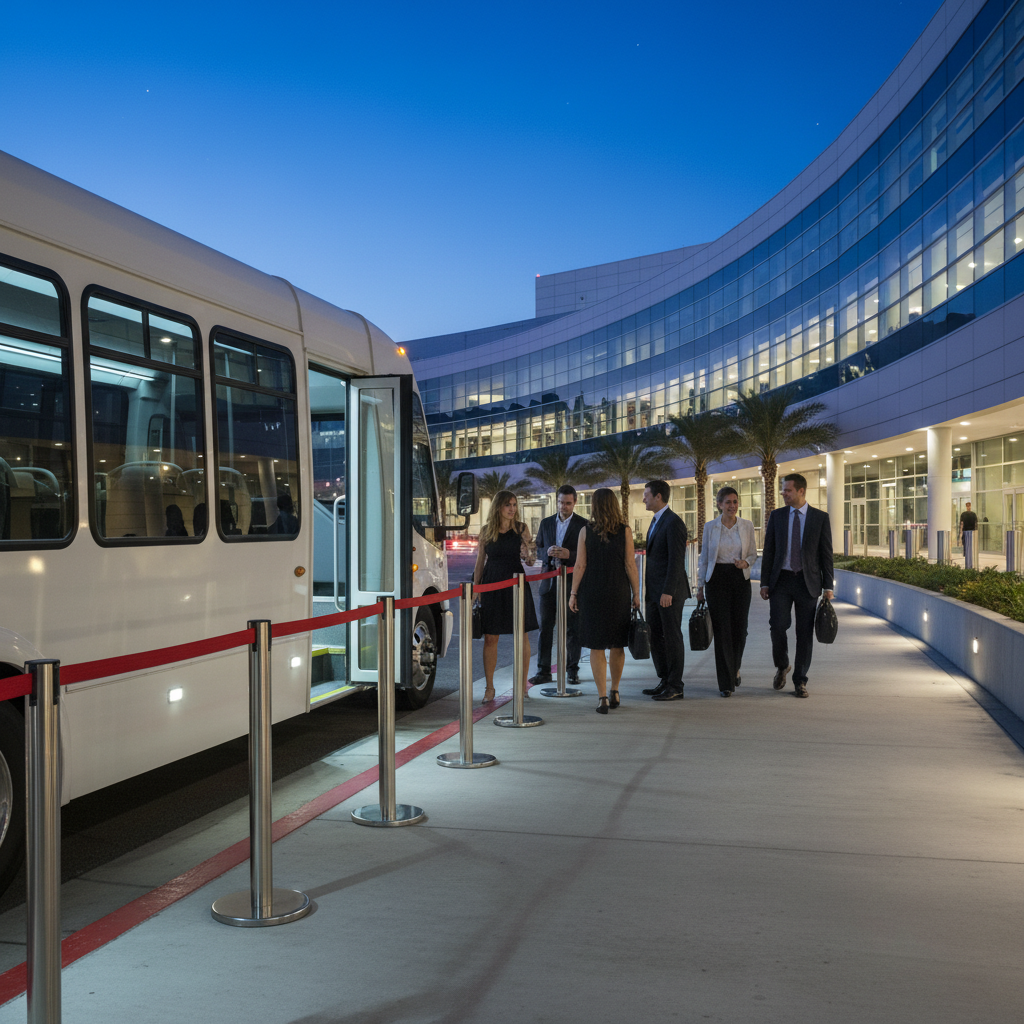
Staffing, signage, shuttles, and event-day operations
Staffing should follow decisions, not simply square footage. A person is most valuable where a driver must choose a direction, where vehicles and pedestrians cross, where priority access must be protected, or where a zone may fill. Assign one parking lead with authority to make changes, then identify zone leads, entrance attendants, crossing marshals, shuttle coordination, and a safety or venue contact.
Give every role a defined handoff
- Parking lead: Owns the operating plan, radio channel, contingencies, and communication with venue management.
- Zone lead: Reports usable capacity, protects reserved areas, and requests a change before the zone becomes blocked.
- Entrance attendant: Directs vehicles to the correct zone and identifies unusual arrivals or access needs.
- Crossing marshal: Controls pedestrian crossings and pauses vehicle flow when necessary.
- Shuttle coordinator: Tracks vehicles, stops, headways, passenger demand, and changes at departure.
- Safety or venue contact: Escalates hazards, accessibility issues, weather concerns, and incidents through the correct channel.
Brief the team on the map, vocabulary, radio etiquette, hand signals, emergency contacts, accessibility expectations, and the trigger for opening another zone. Conduct a short walk-through rather than assuming that an emailed map is understood. Staff should know both where to stand and where not to stand.
Make wayfinding readable
Good signage is visible early, uses one instruction at a time, and remains consistent from the road to the entrance. Use large directional arrows, high contrast, zone labels, and repeated confirmation signs. Place signs before the decision point, not after a driver has already passed the turn.
Prepare a sign schedule that records the message, location, orientation, mounting method, and person responsible for placement. This reduces the risk of a sign being omitted or pointing in the wrong direction. Keep guest-facing language shorter than the operations team’s terminology; “General Parking,” “Accessible Drop-Off,” and “Shuttle Pick-Up” are easier to act on than internal abbreviations.
Decide when shuttles are useful
On-site parking does not automatically eliminate the value of a shuttle. Shuttles may support guests from an overflow area, protect close-in spaces for accessibility, connect a remote parking area, or reduce walking during poor weather. They are useful only when the stop, route, loading behaviour, and communication are clear.
Set a planned service pattern for the arrival peak, then define how service changes at departure. Tell guests where to wait, how to recognize the vehicle, and whether the service is continuous or scheduled. Keep the shuttle stop away from the primary pedestrian crossing and provide a staff contact for guests who need assistance.
Communicate before guests travel
The pre-event email or registration page should include the venue address, arrival recommendation, parking zones, accessible drop-off information, public-transport or shuttle details if applicable, and a reminder to follow staff directions. A simple annotated map is more useful than a long paragraph of directions. Repeat the essential instruction in a reminder close to the event.
For a corporate event venue in Mississauga, parking communication should fit the event’s professional tone while remaining direct. Guests should not have to infer whether a space is reserved, whether a supplier may use the curb, or where they should go after being dropped off.
How to measure the operation and improve it
Measurement turns a parking plan into a repeatable operating system. Record observations without distracting staff from safety. Useful measures include the approximate queue length at the busiest point, average or sampled entry time, time to clear the site after closing, number of blocked or misused priority spaces, accessibility issues, vehicle-pedestrian conflicts, incidents, and questions that guests repeatedly ask.
Interpret the numbers alongside context. A long queue may reflect a security check, a full zone, a road incident, or unclear signage. A quick entry time does not prove success if guests were directed to an unsafe walking route. Combine the observations with staff debriefs and guest feedback, then change one or two controllable elements before the next event.
Final event-day checklist
- Confirm attendance, arrival waves, suppliers, speakers, and expected travel modes.
- Verify the usable parking count and identify the trigger for overflow or redirection.
- Mark accessible parking, access aisles, passenger drop-off, VIP, general, supplier, and rideshare areas.
- Walk every vehicle and pedestrian route, including the farthest space and the accessible path.
- Place and test signs, cones, barriers, lighting, radios, batteries, and staff identification.
- Brief staff on roles, handoffs, radio language, crossings, incidents, weather, and emergency escalation.
- Separate exhibitor or supplier movement from guest ingress through timing or physical routing.
- Confirm shuttle stops, headways, loading procedures, and guest-facing instructions if shuttles are used.
- Monitor the busiest decision points and record queue, delay, accessibility, and safety observations.
- Keep staff in place during the first departure wave and complete a short debrief afterward.
For planners reviewing venue logistics, the Centre’s on-site parking information is one useful part of the venue conversation. Ask the venue team to walk the actual arrival route with you, confirm what the venue manages, and identify which responsibilities remain with the organizer or an external traffic-control provider.
Frequently asked questions
What is event parking logistics management?
It is the planning and operation of parking, vehicle movement, pedestrian routes, staffing, signage, accessibility, shuttles, and incident response for an event. The goal is to move guests safely and predictably from the public road to the venue and back again. A strong plan connects parking decisions to the event schedule and audience rather than treating parking as a last-minute task.
How do I estimate parking demand for an event?
Start with expected attendance, divide guests into audience groups, estimate vehicle occupancy and travel modes, and model the busiest arrival window. Add space and access requirements for suppliers, exhibitors, accessible transport, speakers, and passenger drop-off. Use low- and high-demand scenarios, then establish an overflow or redirection trigger before event day.
How should accessible parking and drop-off be planned?
Place accessible spaces as close as possible to an accessible entrance, with clearly marked spaces, access aisles, and a safe route. Provide a clearly identified passenger drop-off point near the entrance that does not block through traffic. Walk the route in advance and assign staff to keep it clear and answer access questions.
When do an event in Mississauga require additional traffic coordination?
Additional coordination may be needed when an event affects a public road, requires a road closure, uses a large or complex site, or creates unusual traffic and pedestrian conditions. Peel Region states that special-event road-closure applications must be submitted at least 60 days before the event and may require police traffic control and a traffic management plan. Confirm the current municipal, regional, venue, and provincial requirements for the specific event before promoting road changes.
Plan a calmer arrival for your next event
Effective event parking logistics management comes from matching demand to capacity, separating competing movements, protecting accessible routes, staffing decision points, and communicating one clear instruction at each stage. At Mississauga Convention Centre, the available on-site capacity, seven flexible halls, and location near major highways and Toronto Pearson International Airport give planners a practical foundation, but the event-specific operating plan still determines the guest experience.
Start with the arrival waves and walking route, then build the zones, staff plan, signs, contingencies, and measurement process around them. That approach helps corporate planners, exhibitors, wedding coordinators, schools, and community organizers deliver an arrival that feels organized before guests reach the room.
Plan your event with Mississauga Convention Centre
Discuss your agenda, guest profile, access requirements, parking zones, and arrival routes with Mississauga Convention Centre before finalizing your event communications.