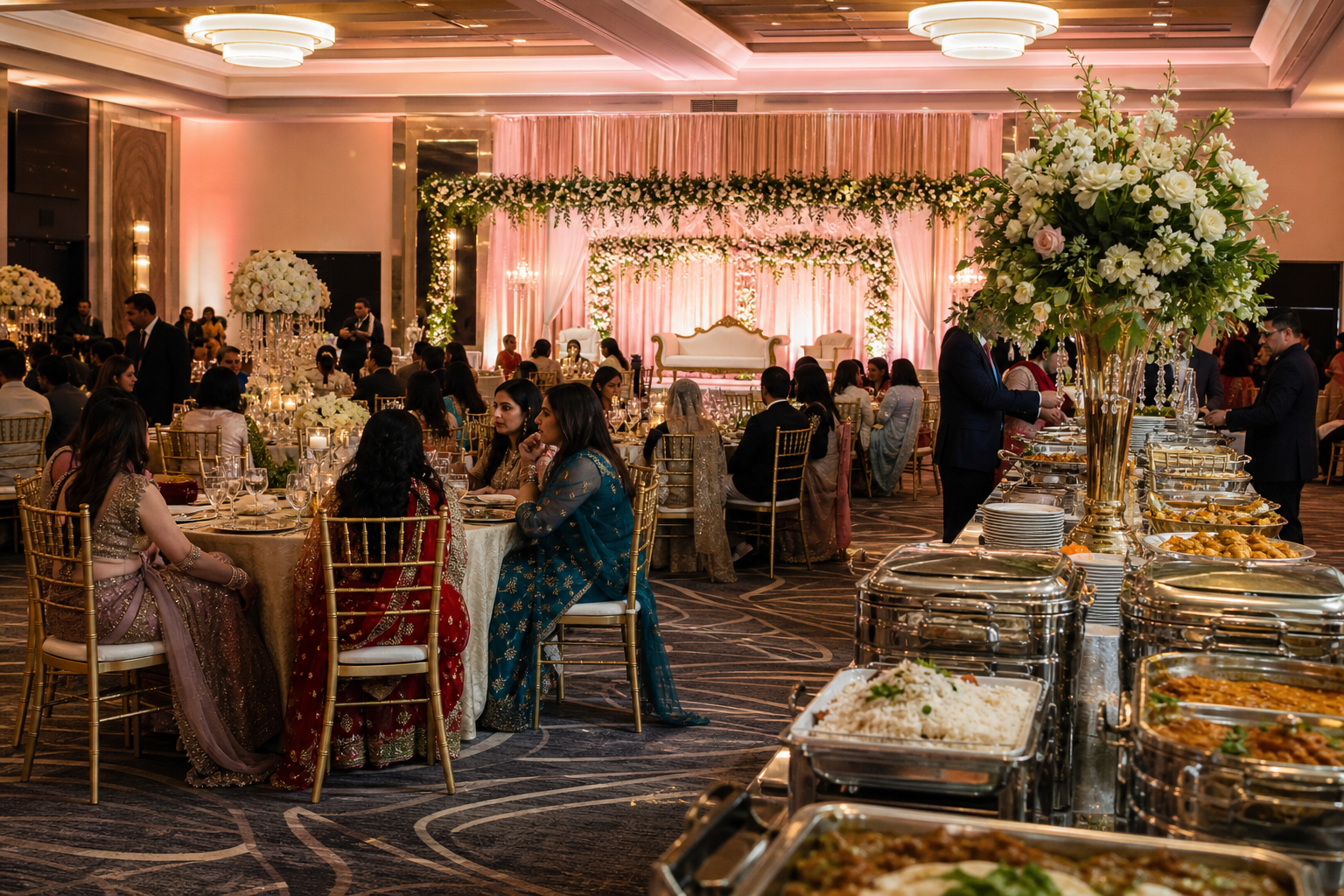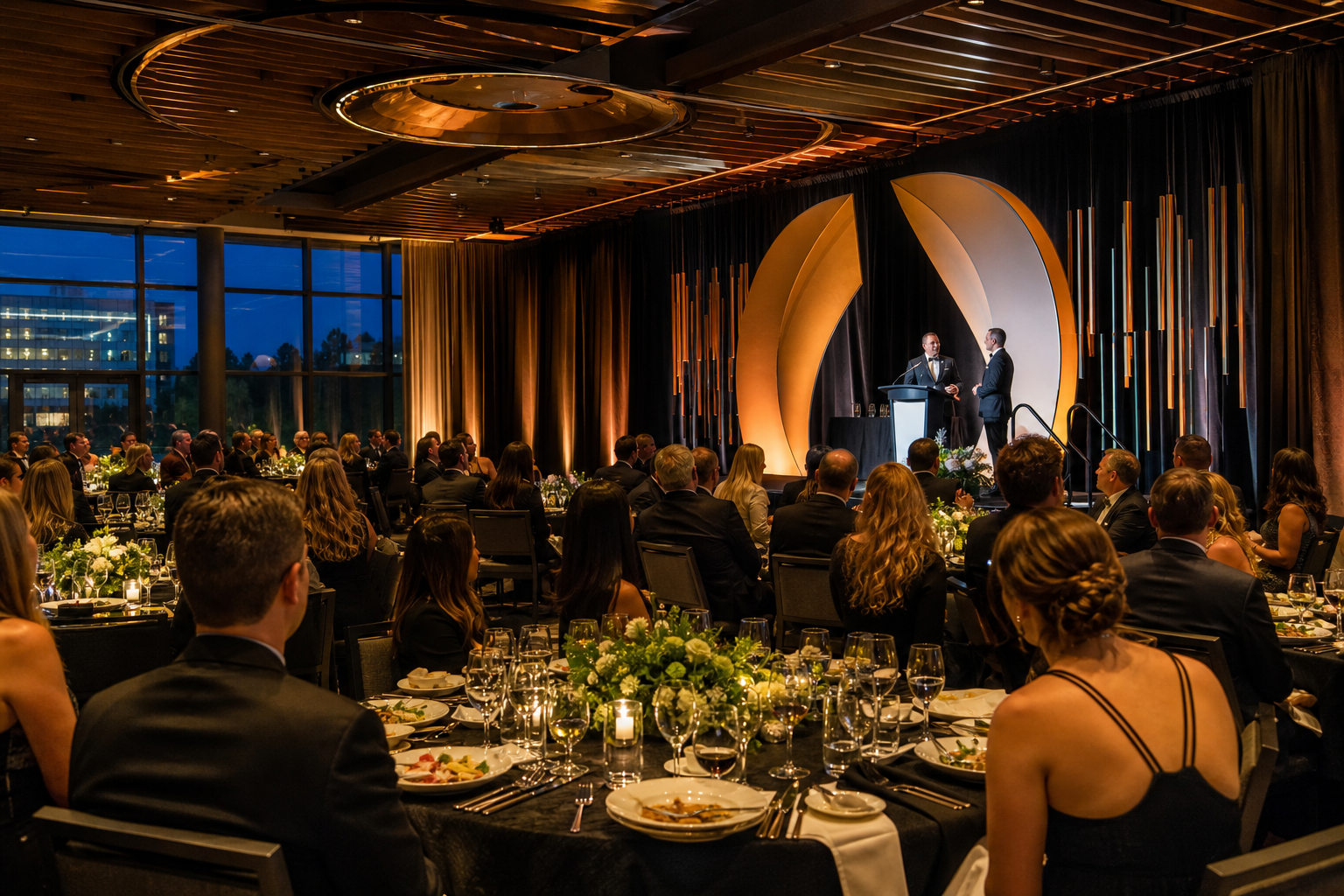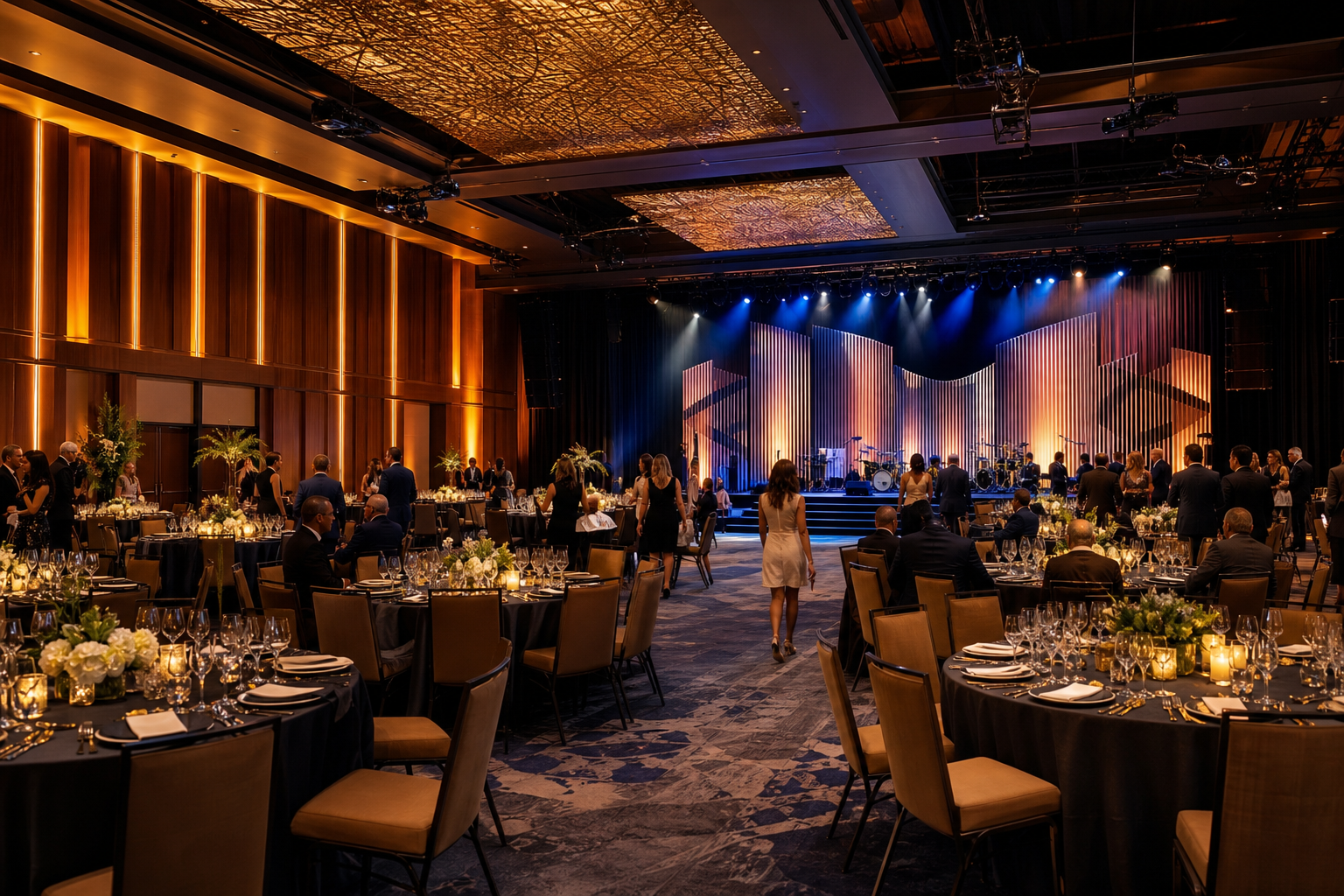
Mississauga Convention Centre

7 Event Lighting Design Tips for Better Mood, Visibility, and Guest Flow

Effective event lighting does more than make a room look attractive. It helps guests find their way, directs attention to speakers or performances, supports photography, and changes the atmosphere as the program develops.

Start by deciding what guests must see and do, then build the lighting around the room layout, schedule, décor, staging, and camera requirements. These seven event lighting design tips can help you create a clear brief for your venue or AV team.

Key Takeaways

  • Define the event’s main purpose before selecting fixtures or colours.
  • Layer ambient, accent, task, stage, and dynamic lighting instead of relying on one effect.
  • Give speakers, performers, screens, and cameras clean, even visibility.
  • Review the lighting plot with the floor plan, staging, dĂ©cor, power routes, and guest flow.
  • Create lighting cues for arrival, meals, speeches, awards, dancing, and closing, then rehearse them.

1. Define What the Lighting Must Help Guests Do

Begin with the event objective, not the fixture list. A corporate presentation needs clear faces, readable screens, and an environment that keeps attention on the speaker. A wedding or gala may place more emphasis on warmth, photographs, décor, and transitions from dinner to dancing.

A trade show needs product and exhibitor visibility, while a school formal needs comfortable circulation, a strong focal area, and an energetic dance floor. Write down the most important guest actions, such as registering, finding tables, watching an award presentation, viewing an exhibit, or moving safely to a patio.

This approach helps resolve competing priorities. If a dramatic colour wash makes a stage difficult to see, the design is serving appearance at the expense of the program.

2. Build the Design in Layers, Not With One Effect

Outdoor event patio at dusk with warm path lights, illuminated signage, ceremony area, and guests walking

A polished lighting plan normally combines several layers. Ambient lighting establishes the general feel of the room. Accent lighting draws attention to a centerpiece, backdrop, sign, architectural feature, or branded area. Task lighting supports registration, dining, exhibit viewing, and reading printed materials.

Stage lighting gives speakers and performers consistent visibility, while dynamic lighting introduces movement for dancing or selected program moments. Options may include ambient washes, pinspots, stage lighting, gobos, dance-floor effects, and outdoor accent lighting.

Lighting approach Primary purpose Useful event moments
Ambient wash Creates an even base level and overall mood Arrival, dining, and networking
Uplighting Adds colour and depth around walls or drape Weddings, galas, and receptions
Pinspots Highlights small focal details Centerpieces, cakes, awards, and signage
Stage wash Keeps presenters and performers visible Speeches, panels, ceremonies, and awards
Gobo projection Adds a pattern, texture, or logo Branding, entrances, and backdrops
Dance-floor effects Creates movement and energy DJ sets and live performances
Outdoor accent lighting Highlights features and supports movement Patios, paths, and ceremony areas

Use restraint when combining layers. A room with strong colour, moving effects, bright screens, and multiple focal points can feel visually confused. Choose one or two dominant features for each moment.

3. Protect Speaker, Guest, and Camera Visibility

Atmospheric lighting should never make the main content difficult to see. Speakers need even light on their faces, performers need enough coverage to move naturally, and guests need unobstructed views of stages and screens.

For presentations and hybrid programs, use stage or key lighting to keep presenters’ faces evenly illuminated on camera. Check that fixtures do not reflect off screens or wash out projected content.

Test the room from the back row, side seating, stage, camera position, and registration area. Ask whether guests can see facial expressions, slides, signage, and performers without squinting or looking into a fixture.

4. Match Lighting to the Floor Plan and Guest Flow

Mark the entrance, registration point, bar, dining area, stage, aisles, restrooms, exhibit zones, dance floor, photo area, and outdoor routes. These spaces do not need equal brightness, but each should be legible and comfortable.

Review the lighting design beside the tables, staging, service routes, screens, and power plan. Before finalizing fixtures, create lighting plots that show how each look supports the room layout, stage, and guest flow.

Mississauga Convention Centre has seven halls of approximately 4,250 square feet each, so a room-by-room plan is more useful than a single generic diagram.

5. Use Light to Reinforce Décor, Branding, and Culture

Select colours and textures that complement linens, florals, stage backdrops, signage, brand palettes, or cultural details. A wedding may use warm, soft light, while a corporate event may use controlled brand colours around the stage and registration areas.

Consider what will appear in photographs. A strong photo area needs a clear focal point, flattering light, and separation from nearby traffic. Pinspots, backdrop lighting, and carefully placed accent fixtures can help, but direct glare or intense colour on faces can produce unhelpful images.

More effects do not necessarily create a better result. Limit the palette, identify the primary focal points, and repeat visual cues across the stage, tables, entrance, and signage.

6. Plan Lighting Looks Around the Run of Show

Create named lighting states for guest arrival, presentation, meal service, awards, performance, dancing, and closing. Each state should have a clear purpose and defined transition.

Put these states into a concise cue sheet. Include the cue name, trigger, responsible person, audio or video connection, and any catering or staging dependency. The lighting operator should know whether a change happens on a speaker’s introduction, video roll, meal course, performance, or room transition.

Keep the number of looks manageable. A smaller set of tested cues is easier to call accurately than a long list of subtle changes that no one has rehearsed.

7. Confirm the Design With a Technical Rehearsal

A lighting plan is complete only when the team has confirmed placement, focus, control, visibility, cable routes, timing, and responsibilities in the actual room. Run the opening, speaker walk-ons, videos, awards, performances, meal transitions, dance-floor change, and closing.

Use the event AV and staging checklist to coordinate room layout, lighting, sound, visuals, safety, responsibilities, rehearsal, and show-day checks. Confirm who can make changes on site and who approves last-minute adjustments.

For outdoor areas, review weather contingencies, path visibility, fixture protection, and the transition between indoor and outdoor lighting. Treat outdoor lighting as part of the guest journey rather than a separate decorative add-on.

Pre-Event Lighting Checklist

  • Priorities: Identify the moments and guest actions needing the most visibility.
  • Lighting layers: Select ambient, accent, task, stage, and dynamic effects by area.
  • Lighting plot: Mark fixtures, focal points, stages, cameras, screens, entrances, and pathways.
  • Floor plan: Coordinate lighting with tables, staging, dĂ©cor, registration, exhibits, service routes, and power.
  • Camera check: Test faces, presentations, reflections, contrast, and sightlines.
  • Cue sheet: List lighting states and their audio, video, speaker, meal, or performance triggers.
  • Rehearsal: Schedule a technical run-through with venue, AV, dĂ©cor, and production teams.
  • Contingencies: Confirm backup responsibilities, outdoor alternatives, cable protection, and approval procedures.

Frequently Asked Questions

What type of lighting is most useful for a corporate presentation?

Start with even stage or key lighting for presenters, controlled ambient light for the audience, and enough separation between the stage and screen. Test the setup from the back of the room and through the presentation camera.

How should wedding or gala lighting change between dinner and dancing?

Dinner benefits from comfortable ambient light, restrained accents, and clear visibility for conversation and service. Dancing can use more movement and colour, while preserving important focal points such as the head table, stage, or dance floor.

What should an event lighting plot include?

It should show the room layout, fixture locations, stage, screens, cameras, focal points, entrances, pathways, power considerations, and lighting states. Review it with staging, décor, AV, and event production.

How can outdoor patio lighting support guest safety and atmosphere?

Use light to make paths, steps, entrances, signage, and gathering areas easy to understand while keeping the atmosphere consistent indoors and outdoors. Confirm weather, power, fixture protection, and the backup plan.

Conclusion: Choose Lighting That Serves the Whole Event

The best event lighting design starts with function. Define what guests need to see and do, layer atmosphere around those priorities, protect faces and screens, and coordinate every fixture with the floor plan, décor, staging, AV, and schedule.

Mississauga Convention Centre is located at 75 Derry Road West and offers in-house audiovisual systems, lighting, staging, technical support, custom décor options, and lighting packages for corporate, wedding, school, social, conference, exhibition, and trade show events. To discuss a lighting-ready event plan, visit Mississauga Convention Centre.
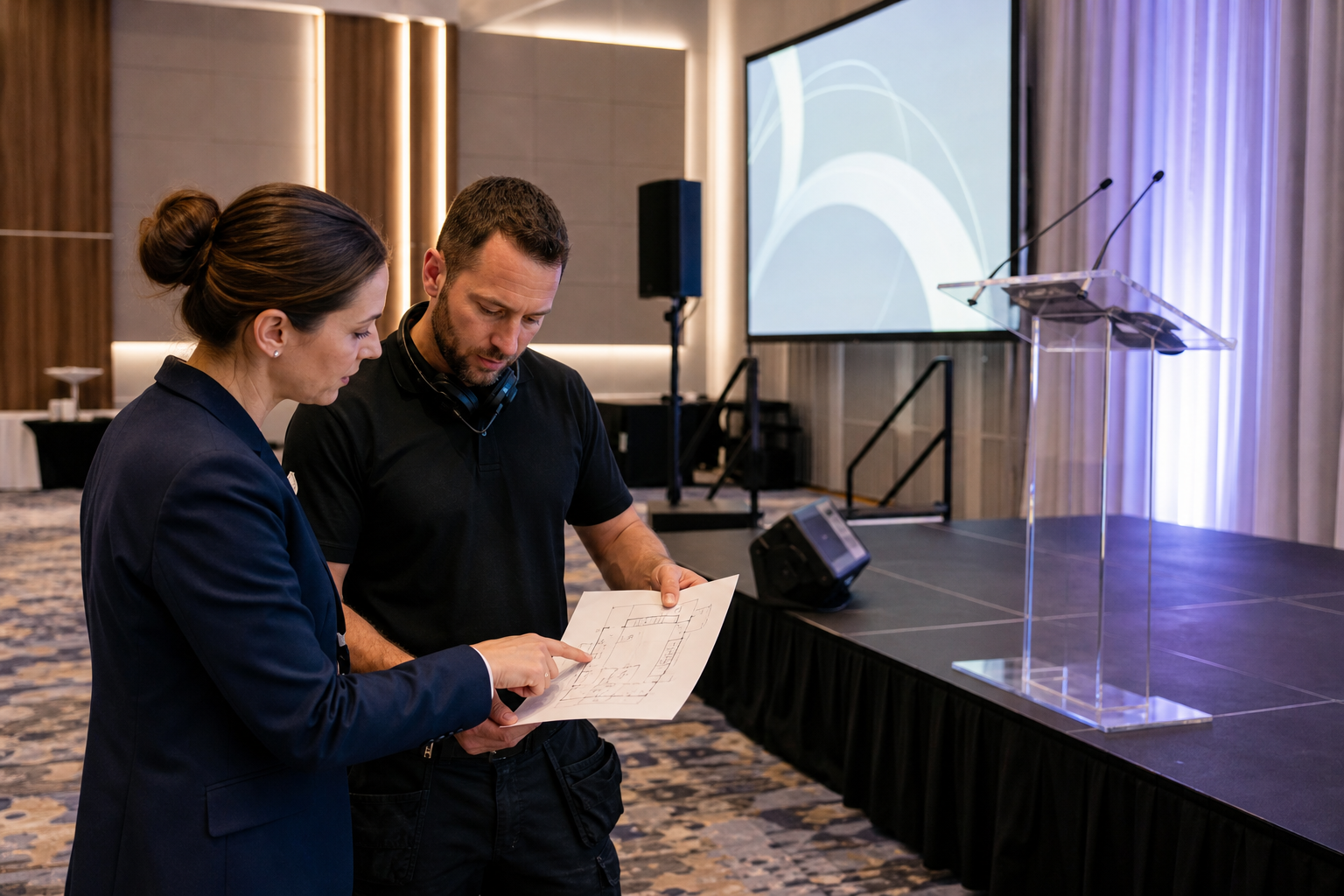
Event AV and Staging Checklist: Plan the Setup Before Show Day

A reliable AV staging setup checklist is more than a list of microphones, screens, and cables. It is a written plan that connects your agenda, room layout, presenter needs, technical requirements, safety checks, and responsibilities before event day.

Start by defining what the event must accomplish, then document how attendees will see and hear the program. Confirm what the venue includes, what a production team must supply, and what still needs testing. This approach works for corporate meetings, conferences, seminars, trade shows, and gala events.

Key Takeaways

  • Creating a detailed AV and staging brief is essential for effective event planning.
  • Room layout significantly impacts sound, visibility, and audience engagement.
  • Conducting a technical rehearsal is crucial to ensure all equipment functions properly.
  • Documenting responsibilities and quote inclusions helps avoid misunderstandings.
  • Accessibility and safety checks are vital for a successful event setup.

Quick summary

Technician testing microphones and presentation inputs while a presenter stands on a conference stage
  • Write an AV and staging brief before requesting or approving a final quote.
  • Assess the room, seating, sightlines, presenter movement, audio coverage, and stage position together.
  • Confirm equipment, operators, setup, teardown, rehearsal time, technical support, and additional charges in writing.
  • Check power, cable routes, accessibility, trip hazards, and certified electrical equipment with the appropriate venue or production professionals.
  • Run a technical rehearsal, resolve open issues, and complete a short show-day walk-through.

1. Start with a written AV and staging brief

Begin with the event rather than the equipment. Record the event type, date, attendance, agenda, room format, stage position, speakers, panelists, presentation formats, videos, branding, lighting expectations, staging needs, remote participation, testing, rehearsal, setup, teardown, and technical support.

Describe the outcome you need. For example, a panel discussion may require clear speech for every panelist and smooth speaker changes, while a product presentation may require strong presentation visibility, playback testing, and a defined cueing process. A useful AV brief helps a venue respond to the actual event instead of interpreting “AV required” in general terms.

Stop point: Do not approve a final setup or quote until the brief identifies the agenda, room arrangement, technical activities, testing expectations, and responsible parties.

2. Assess the room, audience, and layout

Event team securing cable covers and checking an accessible route beside staged seating

Room layout determines how sound travels, where presenters can move, what attendees can see, and where displays or cameras can be positioned. Review the expected audience, presentation style, panel size, audience participation, meal service, networking, demonstrations, and any exhibition elements before choosing a configuration.

Classroom and theater arrangements can prioritize forward-facing presentations. Boardroom or hollow-square arrangements support discussion and eye contact but can make camera coverage and display placement more difficult. Banquet and gala layouts introduce additional sightline and speech coverage considerations, while trade show arrangements must account for exhibitor access and visitor flow.

During a site visit, walk the room from the audience, stage, control position, and entrance. Confirm the assigned room rather than relying only on a general venue description. A venue with multiple halls can support different event scales, but the suitable configuration still depends on your specific attendance and program.

3. Map sightlines, presenter movement, and staging

Mark where attendees, speakers, panelists, operators, and cameras will be positioned. Check whether every audience section can see the presentation area, lectern, stage activity, and any displays without turning excessively or looking through an obstruction.

Document the stage or presentation area, lectern location, walk-on route, presenter holding area, branding locations, panel seating, confidence-monitor needs, and operator position. If the event includes videos, demonstrations, or a remote contributor, include those viewing and cueing requirements in the same layout review.

Stop point: Revise the layout if any attendee group must stand, twist, look around an obstruction, or depend on an unconfirmed display to follow the program. Do not solve a sightline problem by adding equipment before confirming that the room arrangement itself is appropriate.

4. Specify the audio plan before the visuals

Audio problems can make an otherwise polished event unusable, so list every person and activity that must be heard. Include keynote speakers, panelists, audience questions, moderators, announcements, walk-on music, videos, playback content, and remote contributors if applicable.

Ask the venue or production team to confirm the suitable sound arrangement, microphone coverage, sound-check ownership, operator availability, adjustments during the event, and backup procedures. Do not assume that a general statement about professional audiovisual systems confirms a particular microphone type, quantity, speaker arrangement, operator, or backup device.

Include speaker transitions in the rehearsal plan. Test speech, playback, handoffs, and audience questions from the positions where they will actually occur. The room, seating, presenter movement, and acoustic conditions should guide the final audio plan.

5. Plan displays, presentation content, and cameras

Separate the visual result from the equipment request. State what attendees must see, where they must see it, and how presenters will control or monitor content. List slide presentations, videos, demonstrations, logos, lower-thirds, captions, remote participants, recording needs, and any platform-specific requirements known at the planning stage.

Confirm the presentation handoff process. Decide whether files will be collected in advance, supplied on a presenter device, or managed through another agreed workflow. Test videos with sound, transitions, fonts, aspect ratios, and embedded content rather than checking only that a slide deck opens.

Cameras, streaming, recording, bandwidth, and hybrid participation must be confirmed for the specific event. They should not be inferred from a venue’s general AV description. If remote participation matters, document who supplies the platform, manages the call, monitors remote audio, supports presenters, and handles a connection failure.

6. Coordinate lighting and staging requirements

Lighting should make presenters visible, support the desired atmosphere, and work with any camera or recording plan. Document the presentation area, speaker movement, panel arrangement, branding, décor, audience focus, and any transitions between presentations, meals, performances, or awards.

Describe staging as an activity and space requirement, not only as a product name. Confirm the intended stage arrangement, access routes, lectern position, furniture, branding surfaces, and clearance with the venue or qualified production team. Exact dimensions, load limits, rigging points, and room-specific capabilities require event-specific confirmation.

Every lighting or staging enhancement should appear clearly in the quote. Ask whether it is included in the selected package, supplied by the venue, operated by venue technicians, priced separately, or assigned to an external production team.

7. Confirm power, connectivity, cable routes, and backups

Create a device and connection list that names each input, source, display, playback device, control position, and network-dependent function. Label cable routes and identify who supplies adapters, signal conversion, extension equipment, and backup devices.

Ask where power is available, how equipment will be connected, whether dedicated network access is required, and who is responsible for troubleshooting. Do not assume that advertised AV capability confirms power capacity, connection type, bandwidth, cable length, or backup availability.

Use a written issue log during testing. Record the problem, assigned owner, resolution, and fallback plan. Qualified venue or production professionals should confirm electrical distribution and any specialized requirements. Ontario guidance states that electrical equipment used in temporary performance setups must be approved and bear the certification mark of an appropriately accredited certification organization. Review the Ontario electrical guidance for the applicable safety principle.

8. Complete electrical, safety, and accessibility checks

Inspect cable paths, entrances, aisles, exits, presenter routes, audience circulation, and operator positions. Keep wires out of walking paths where possible and use an approved method for securing or covering any unavoidable crossing. Do not alter electrical systems or rigging without the venue and qualified professionals.

Check that people using mobility devices can reach the relevant seating, presentation areas, washrooms, and exits. Make emergency and safety information available in a form attendees can access. Ontario accessibility guidance identifies electrical wires as trip hazards and recommends addressing barriers and safety information during event planning. Use the Ontario accessible-events guidance as a planning reference.

Stop point: Do not open the room to attendees while a cable route, blocked aisle, inaccessible movement path, unapproved electrical device, or unclear emergency route remains unresolved.

9. Put responsibilities and quote inclusions in writing

A strong brief distinguishes planning decisions from venue confirmations and production tasks. Use a responsibility matrix like this before signing off:

Planner decides Venue confirms Production team supplies or operates
Agenda, audience, layout, speakers, content, branding, and desired outcome Assigned room, available services, setup rules, access, support hours, and package inclusions Agreed equipment, operators, setup, cueing, testing, and troubleshooting
Audio, visual, lighting, staging, hybrid, and accessibility requirements Power, connectivity, room conditions, technical contacts, and permitted installation methods Device connections, cable management, playback, backups, and technical operation
Rehearsal schedule, show flow, and approval of the final plan Rehearsal access, technician availability, overtime terms, teardown rules, and additional charges Technical rehearsal, show-day support, changeovers, and documented fallback procedures

Ask for each item to be marked included, excluded, client-supplied, separately priced, or subject to confirmation. This is especially important for operators, rehearsal time, setup and teardown, remote participation, recording, additional technician hours, and custom lighting or staging.

10. Run a technical rehearsal with stop points

Use the rehearsal to test the complete sequence, not isolated equipment. Start with power and connectivity, then verify every input, microphone, presentation file, video, playback source, display, lighting cue, stage transition, and presenter handoff.

Walk the room from several audience positions. Rehearse speakers entering, using the lectern, joining a panel, answering questions, and moving away from the presentation area. Test remote participation if it is part of the event, then confirm the fallback if the connection, platform, or remote audio fails.

Use these stop points:

  • Stop if speech is unclear, distorted, missing, or not covered in an audience section.
  • Stop if presentation content is unreadable, playback audio is absent, or a required input has no confirmed owner.
  • Stop if stage movement, lighting, or sightlines create a visibility or safety problem.
  • Stop if no named person can make technical adjustments during the event.

For a broader sequence covering room assessment, cameras, microphones, lighting, power, backups, rehearsal, and day-of timing, use these conference room setup tips.

11. Complete the final show-day walk-through

Keep the final walk-through shorter than the technical rehearsal. Confirm that the room matches the approved plan, devices are connected and labeled, presenter files are available, microphones are placed, lighting and staging are in position, and the technical contact is present or reachable.

  • Check stage, lectern, panel seating, displays, audience seating, and accessible routes.
  • Confirm input labels, playback files, cue notes, presenter order, and operator instructions.
  • Inspect cable safety, aisles, exits, emergency information, and equipment placement.
  • Verify the contact for technical adjustments, venue operations, and emergencies.
  • Confirm when equipment will be removed and who controls teardown access.

Questions to ask an event venue before finalizing the setup

When comparing an event venue, ask questions that convert broad capabilities into event-specific commitments:

  • Which professional AV systems, lighting, staging, and technical support are available for this room and event format?
  • What is included in the quote, and what requires a separate charge or production provider?
  • Who sets up, operates, tests, adjusts, and removes each technical element?
  • When can the team access the room for setup and rehearsal?
  • Who is available during the event if audio, visuals, lighting, or connectivity needs adjustment?
  • What power, network, cable-routing, loading, and accessibility requirements must be confirmed before arrival?
  • Are remote participation, recording, streaming, or specialized production services available for this event, and under whose responsibility?
  • What happens if the schedule changes or additional technician time is needed?

Mississauga Convention Centre identifies professional audiovisual systems, lighting, staging, and technical support among its corporate event services. Confirm the exact equipment, staffing, testing, and inclusions for your date and program rather than assuming that every service is part of a standard package.

Copy-and-send AV staging checklist

Send the following information to the venue or production team and request written confirmation:

  • Event date, type, attendance, agenda, room, seating layout, and stage position.
  • Speakers, panelists, audience participation, presenter movement, and show cues.
  • Audio requirements, presentation files, videos, playback, displays, cameras, and remote participation.
  • Lighting, staging, branding, dĂ©cor, furniture, accessibility, and audience-flow requirements.
  • Power, connectivity, cable routes, input sources, device labels, backups, and technical contacts.
  • Setup, teardown, sound check, technical rehearsal, operator coverage, and show-day support.
  • Included services, client-supplied items, add-ons, overtime, additional charges, and fallback procedures.

FAQ

What should an AV staging setup checklist include?

It should include the agenda, attendance, room layout, sightlines, audio, presentation content, displays, cameras or remote participation, lighting, staging, power, connectivity, cable safety, accessibility, setup, teardown, rehearsal, technical support, backups, and quote responsibilities.

Who is responsible for AV setup and technical support at an event venue?

Responsibility depends on the contract and event plan. The venue may confirm room services and available technical support, while a venue technician or production team may handle setup, operation, testing, and troubleshooting. Put each task and owner in writing.

Should a technical rehearsal be included in the venue quote?

Ask for rehearsal access, duration, staffing, equipment availability, and any additional technician or room charges to be stated in the quote. A general AV inclusion does not automatically confirm rehearsal time or operator coverage.

How can planners check electrical and accessibility risks in an event setup?

Inspect cable routes, walking paths, aisles, exits, accessible movement routes, emergency information, and equipment certification with the venue or qualified professionals. Resolve trip hazards, blocked routes, inaccessible areas, and unapproved equipment before attendees enter the room.

Conclusion: finalize the brief before booking the setup

The best AV staging setup checklist begins with the event’s purpose and ends with a tested, assigned, and safe operating plan. Match the room and layout to the agenda, specify audio before choosing visual details, document lighting and staging requirements, and separate venue responsibilities from production-team tasks.

Before show day, confirm every quote inclusion, test the complete sequence, resolve sightline and sound problems, and complete the final safety and accessibility walk-through. If a requirement is unconfirmed, treat it as an open planning issue rather than an assumed capability.

For corporate meetings, conferences, seminars, trade shows, and gala events requiring professional audiovisual systems, lighting, staging, and technical support, contact Mississauga Convention Centre to discuss the requirements for your event.

7 South Asian Wedding Menu Decisions That Shape Service and Guest Experience

The strongest South Asian wedding menu is not built by choosing dishes one at a time. It starts with the guest profile, wedding format, dietary requirements, service style, schedule, and venue logistics, then turns those decisions into a menu the caterer can quote accurately.

Whether you are comparing South Asian wedding catering in Mississauga or planning across the GTA, use the seven decisions below to make the conversation more productive. The goal is not to create the longest menu. It is to create a menu that respects your traditions, serves guests smoothly, and fits the way your celebration will actually run.

Key Takeaways

  • Understanding your guest profile and regional preferences is essential for a successful wedding menu.
  • Clarifying dietary requirements early can prevent complications during meal service.
  • Choosing the right service style can enhance the overall guest experience.
  • Aligning the menu with the wedding timeline ensures a smooth flow of events.
  • Requesting a detailed quote helps clarify expectations and avoid surprises.

Quick summary

Couple and family reviewing South Asian wedding menu options with venue coordinator
  • Separate essential regional preferences from optional menu variety before meeting the caterer.
  • List vegetarian, Jain, Pakistani Halal, allergy-related, and other dietary requirements early.
  • Choose a service style that suits your guest count, formality, room layout, and desired pace.
  • Coordinate meal service with ceremonies, entrances, speeches, performances, and room changes.
  • Request a quote that clearly identifies menu selections, service assumptions, venue support, and enhancements.

1. Start with guest profile and regional preferences

A South Asian wedding may bring together guests with different regional backgrounds, family traditions, ages, and expectations. Before discussing individual dishes, write down who you are serving and which culinary preferences are essential to the couple and their families.

Separate your priorities into three groups: must-have regional options, preferred additions, and welcome extras. This prevents a mixed menu from becoming so broad that it is difficult to coordinate, explain, or serve consistently. Consider whether the reception is primarily centred on one regional tradition or needs a balanced selection for a multicultural guest list.

Ask the venue or caterer how the proposed menu will represent those preferences, how choices will appear in the quote, and whether the same service plan can accommodate different guest groups. Mississauga Convention Centre’s Indian wedding offering identifies South Asian, Gujarati, vegetarian, Jain, Halal, North Indian, and South Indian options, with customization available. When comparing South Asian wedding menus, use that regional detail as a starting point, then confirm the options available for your date and event.

2. Confirm dietary requirements before choosing dishes

Wedding reception hall with round tables, stage, dance floor, and food-service access

Dietary planning should happen before the menu is finalized, not after the main selections have been made. Create a working list of vegetarian, Jain, Pakistani Halal, allergy-related, and other dietary requirements, while noting whether each applies to a few guests or a substantial part of the reception.

Requirements may affect ingredients, preparation, service separation, labels, substitutions, and the way guests access food. Ask specific questions: Which dietary options can be included in the main menu? Can substitutions be made? How will special meals or stations be identified? What information should be provided about ingredients and cross-contact?

Mississauga Convention Centre lists South Asian and Pakistani Halal catering among its in-house options, and its Indian wedding offering also identifies vegetarian, Jain, and Halal selections. That supports an initial conversation, but do not assume that a menu label answers every dietary question. Ask the venue to confirm the exact menu, preparation arrangements, and event-specific accommodations in writing.

3. Match the service style to guest count and event priorities

The same menu can feel very different when it is served as a buffet, through stations, by plated service, or through another format. Your choice should reflect the balance you want between variety, formality, guest movement, service pace, and control over portions.

A buffet may make it easier for guests to choose among several options, while stations can help divide traffic and create a more interactive experience. Plated service may offer a more structured flow, but it requires accurate meal selections and careful timing. None of these formats is automatically best. The right choice depends on the menu, room, schedule, and guest profile.

Give the caterer your expected guest count, approximate age mix, event format, and timing expectations. Ask how the proposed service style affects table service, queue management, meal duration, staffing assumptions, replenishment, and access for guests with mobility needs. Confirm whether the quote is based on a particular format and what changes if your final head count moves.

4. Build the menu around the wedding timeline

Food service must fit around the moments that make up the celebration. Ceremonies, entrances, cocktail periods, speeches, performances, photographs, room changes, and dancing can all affect when guests are seated and when food can be served.

Prepare a simple run-of-show before finalizing the menu. Mark the expected arrival period, ceremony or reception start, meal service, speeches, performances, and any transition between spaces. Then ask the venue and caterer where food preparation, service, clearing, and replenishment fit within that timeline.

For a broader planning framework, South Asian wedding menu planning should be considered alongside ceremony timing, room flow, staging, and guest logistics. A menu that looks excellent on paper may still create pressure if guests are expected to queue during an entrance or if speeches begin before most tables have been served.

Ask whether the menu and service plan can support your program without rushing guests. Confirm the order of service, who communicates timing changes, and how delays will be handled if a ceremony or performance runs longer than expected.

5. Check room layout, AV, staging, and guest flow

Menu decisions are also room-planning decisions. Buffet lines, food stations, service access, head tables, dance floors, stages, guest seating, and photography areas all compete for space. If food is difficult to reach, it can affect both guest comfort and the pace of the evening.

Ask the venue to review the proposed menu alongside a preliminary floor plan. Consider where guests will enter the meal area, how queues will form, whether tables have clear access, and how servers or replenishment staff will move without interrupting speeches or performances.

Production requirements matter as well. Mississauga Convention Centre describes professional audiovisual systems, lighting, staging, and technical support as part of its event services. Confirm which elements support your particular celebration, including microphones, music, presentations, entrances, performances, and stage placement. Also ask whether décor, lighting packages, or an outdoor patio option changes the usable room plan.

Do not approve a menu in isolation from the venue layout. A site visit, measured plan, or virtual review can help your family, planner, caterer, and technical team discuss the same version of the event.

6. Clarify customization and menu review details

Customization can mean different things. It may involve combining regional preferences, adding vegetarian or Jain selections, adjusting a service sequence, substituting an item, or creating separate choices for specific guest groups. Ask what can be changed and at what stage decisions become fixed.

Bring a written list of requested changes rather than relying on informal conversations. For every proposed adjustment, ask whether it affects ingredients, presentation, service timing, dietary labelling, guest access, or the quote. Confirm how the final selections will be documented so the couple, family, planner, venue, and catering team are working from the same menu.

Mississauga Convention Centre states that its Indian wedding menus can be customized to suit preferences and traditions. That is useful context when beginning the discussion, but the specific combination of regional, vegetarian, Jain, and Halal requirements should still be confirmed for your event. Ask about the menu review process, final approval deadline, and how late guest-count or dietary updates can be handled.

7. Request a quote that includes food and venue logistics

A useful quote should allow you to understand what you are paying for and what still needs confirmation. Provide the event date, estimated guest count, reception format, preferred cuisines, dietary categories, service style, program requirements, and any ceremony or room-flow considerations.

Ask the quote to identify the menu selections, service format, guest-count assumptions, dietary accommodations, staffing or service conditions, and optional items. Review venue-related elements at the same time, including audiovisual support, lighting, staging, décor, patio use, room configuration, and technical requirements.

Mississauga Convention Centre is located at 75 Derry Rd W in Mississauga, near major highways and Toronto Pearson International Airport. The venue describes seven halls of approximately 4,250 square feet each, total capacity exceeding 2,200 guests, and approximately 700 on-site parking spaces. Ask how the selected room, arrival plan, parking, supplier access, and guest movement relate to your specific event rather than treating general venue capacity as a guaranteed layout.

Pricing is customized according to event details and selected services, so request clarification on every inclusion, enhancement, assumption, and potential change. A clear quote is easier to compare than a low headline figure with important services left undefined.

South Asian wedding menu consultation checklist

Take this checklist to your venue or caterer consultation:

  • Guest profile: What regional cuisines and traditions are essential, preferred, or optional?
  • Dietary needs: How many guests require vegetarian, Jain, Pakistani Halal, allergy-aware, or other accommodations?
  • Service style: Which format best suits the guest count, formality, room, and desired pace?
  • Timeline: When will ceremonies, entrances, speeches, performances, photographs, and meal service happen?
  • Room flow: Where will food be placed, and how will guests, servers, performers, and suppliers move?
  • Customization: Which substitutions or regional combinations are possible, and when must they be approved?
  • Quote: Are menu, service, dietary accommodations, AV, staging, lighting, dĂ©cor, parking, and other enhancements clearly identified?

FAQ

Can a South Asian wedding menu include Gujarati, vegetarian, Jain, and Halal options together?

It may be possible to plan those categories together, but the exact combination, preparation requirements, menu choices, and service arrangements must be confirmed with the venue or caterer. Ask how each category will be represented in the final menu and quote.

What should couples ask about Pakistani Halal wedding catering before booking?

Ask which Pakistani Halal menu options are available, how dietary requirements are documented, whether substitutions are possible, how food will be identified during service, and what preparation or certification information the venue can provide. Do not assume that the phrase “Halal menu” confirms every requirement your family may have.

How does guest count affect South Asian wedding catering service?

Guest count can influence the practical choice of service format, queue management, room layout, replenishment, timing, and the assumptions used in a quote. Provide an expected range as early as possible and ask how changes to the final count affect the plan.

What information should be ready before requesting a wedding menu quote?

Prepare the date, estimated guest count, reception format, regional preferences, dietary categories, preferred service style, event timeline, room or staging needs, and any décor or AV requirements. The more complete this brief is, the more useful and comparable the quote should be.

Make the menu support the whole celebration

South Asian wedding menu planning works best when food is treated as part of the full event design. Start with the people you are serving, then connect regional preferences and dietary needs to service style, guest count, timing, room flow, production, customization, and the quote.

For couples and planners seeking a venue with in-house South Asian and Pakistani Halal catering, regional menu options, professional AV and staging support, scalable halls, and GTA access, discuss your requirements directly with Mississauga Convention Centre.
7 Gala Dinner Menu Decisions That Shape Service, Timing, and Guest Experience

Effective gala dinner menu planning starts with the event, not the dish list. The right menu depends on whether guests are attending an awards night, fundraiser, client appreciation event, networking reception, or formal celebration, as well as how much time the program allows for dining and movement.

Before comparing individual dishes, decide how food should be served, when guests will eat, what dietary and cultural requirements must be accommodated, and how the room will support service. The seven decisions below can help you prepare a focused brief for a venue or caterer.

Gala dinner menu formats at a glance

There is no single best format for every gala. Use the comparison below to identify the option that fits your program and guest experience, then refine the menu with the venue or caterer.

Format Strengths Planning considerations Best fit
Plated meal Formal presentation and predictable seating Requires coordinated table service and a protected dining window Awards, recognition, and formal corporate dinners
Buffet or stations Greater guest choice and natural movement Needs thoughtful placement, queue management, and clear access Networking-focused galas and varied preferences
Reception-style service Encourages conversation and circulation Food planning must support guests who may not be seated for a full meal Mixers, fundraising receptions, and relationship-building events
Hybrid service Combines structured dining with later movement Transitions must be reflected in the run of show and room plan Programs that become more social later

1. Start with the gala’s purpose

Ballroom floor plan showing tables, buffet stations, stage, aisles, and service routes

The purpose of the gala should determine the role food plays in the evening. A recognition event may need guests focused on the stage during awards, while a fundraising gala may need time for conversation, auctions, pledges, or sponsor engagement. A client appreciation dinner may place more emphasis on relaxed interaction and hospitality.

Write the primary objective in one sentence before discussing the menu. Also identify secondary priorities such as formality, networking, entertainment, cultural celebration, or sponsor visibility. When priorities conflict, decide which one should guide the menu, or consider a hybrid structure that separates the two parts of the evening.

2. Choose the service style before the dishes

Compare the service style against the event format and guest profile before selecting specific dishes. This prevents a menu from looking appealing on paper but working poorly with the room or schedule.

A plated meal can support a polished, formal experience and help keep guests seated during presentations. Buffets and chef stations can offer more choice, but they require space for queues and movement. Reception-style service works when conversation and circulation are central, while hybrid service can provide structured dining early and reopen movement later.

3. Build the menu around the program timeline

Food service should have a defined place in the run of show. List guest arrival, networking, opening remarks, dinner, awards, entertainment, fundraising activities, closing remarks, and any transition to dancing or informal conversation.

Identify when guests must be seated, when they can move freely, and when the stage needs uninterrupted attention. Share the schedule with catering and production teams early. Mississauga Convention Centre describes its event services as including professional AV systems, lighting, staging, and technical support, which is relevant when menu service must be coordinated with production.

Do not promise a service time before the venue has reviewed the guest count, room configuration, menu structure, and program. Ask the venue to identify realistic service windows and any transitions that may need adjustment.

4. Plan for the guest profile and dietary requirements

Prepare a guest profile before requesting menu recommendations. Include estimated attendance, VIP considerations, allergies, dietary restrictions, accessibility-related needs, and preferences important to the audience.

Separate confirmed requirements from assumptions. Ask how dietary options will be identified, communicated, and served, and whether alternatives are available within the chosen service format. Provide the best available information even if the guest list is not final.

5. Confirm multicultural and Halal menu needs early

For a multicultural gala, cuisine is part of the guest experience and should be treated as an early planning decision. Ask which cuisines, preparation requirements, and menu choices matter to the audience, and whether those needs apply to the full menu or selected options.

Mississauga Convention Centre’s verified in-house catering includes South Asian, Pakistani Halal, Middle Eastern, Sri Lankan, Caribbean, and Continental cuisines. This range can give planners a useful starting point, but the final menu, preparation details, and available options should be confirmed directly with the venue.

State whether Pakistani Halal options are required, whether separate alternatives are needed for other dietary restrictions, and whether guests should choose between different menu directions. Do not assume that a broad cuisine category addresses every guest’s needs.

6. Coordinate the menu with the floor plan and service routes

Food service works best when it is designed with the room rather than added after the seating chart is complete. Coordinate the gala dinner floor plan with service routes and table style so guests, servers, presenters, and equipment can move without competing for the same space.

For plated meals, consider how tables will be reached and how service will coexist with aisles, stage access, and sightlines. For buffets or stations, consider queue locations, return paths, accessibility, and whether guests will miss a key program moment while collecting food.

The plan should account for doors, bars, buffets, staging, AV equipment, and sponsor areas. Ask for a diagram that reflects the selected menu format, then review it with catering and production contacts when the guest count or room plan changes.

7. Match the menu plan to venue capabilities and the quote brief

A gala menu is only one part of the venue decision. Confirm the available room configuration, event scale, catering scope, AV, lighting, staging, technical support, parking, and package or décor enhancements.

Mississauga Convention Centre offers seven halls of approximately 4,250 square feet each, total capacity for more than 2,200 guests, and approximately 700 on-site parking spaces. It also provides in-house catering and integrated AV, lighting, staging, and technical support.

Ask how the selected menu interacts with the proposed room. Mississauga Convention Centre indicates that pricing is based on a tailored quote involving event type, size, menu, and selected enhancements. Treat those variables as part of your brief and clarify what is bundled, optional, or dependent on final details.

Pre-quote gala menu checklist

  • Purpose: Awards, fundraising, networking, recognition, appreciation, or celebration.
  • Event details: Date, location, duration, and estimated attendance.
  • Guest profile: VIPs, groups, accessibility needs, and expected interaction patterns.
  • Service format: Plated, buffet, stations, reception-style, or hybrid.
  • Menu requirements: Cuisine preferences, Pakistani Halal needs, allergies, and dietary restrictions.
  • Program schedule: Arrival, networking, meal windows, speeches, awards, entertainment, and closing activities.
  • Room and production: Table style, stage, screens, microphones, lighting, staging, bars, and buffets.
  • Enhancements: DĂ©cor, lighting packages, technical support, or other additions.

A complete brief helps the venue assess the event as a whole and makes proposals easier to compare.

Frequently asked questions

Which gala dinner service style works best for an awards or recognition event?

A plated meal often suits a formal awards program because it creates a defined dining structure and can help keep guests seated during presentations. The final choice depends on the schedule, guest profile, room layout, and venue recommendation.

How early should dietary and Halal menu requirements be included?

Include them in the first brief, even if the guest list is not final. Early information helps the venue explain options and reflect requirements accurately in the proposed menu and quote.

What information does a venue need for a gala dinner quote?

Provide the purpose, date, attendance, service format, menu direction, dietary and cultural requirements, program schedule, room needs, AV and staging requirements, and desired enhancements.

Conclusion: Make the menu serve the gala

Strong gala dinner menu planning begins with purpose and continues through service style, program timing, guest requirements, cultural preferences, floor-plan coordination, and venue capabilities. Choosing dishes becomes easier once those decisions are settled.

Prepare one concise brief explaining what the event should achieve, how guests should experience it, when food can be served, and what the room and production teams must support. Review those requirements with Mississauga Convention Centre.

7 Decisions That Shape a Wedding Reception Timeline Checklist

A useful wedding reception timeline checklist is not a rigid script. It is a shared running order connecting guest arrival, ceremony transitions, meal service, speeches, traditions, dancing, and closing activities while leaving room for real-life changes.

Start with the elements that cannot move, then build around them. Ceremony location, meal format, venue access, cultural traditions, photography, entertainment cues, and the required event end time should shape the order.

Contents

1. Set the guest arrival and venue-access window first

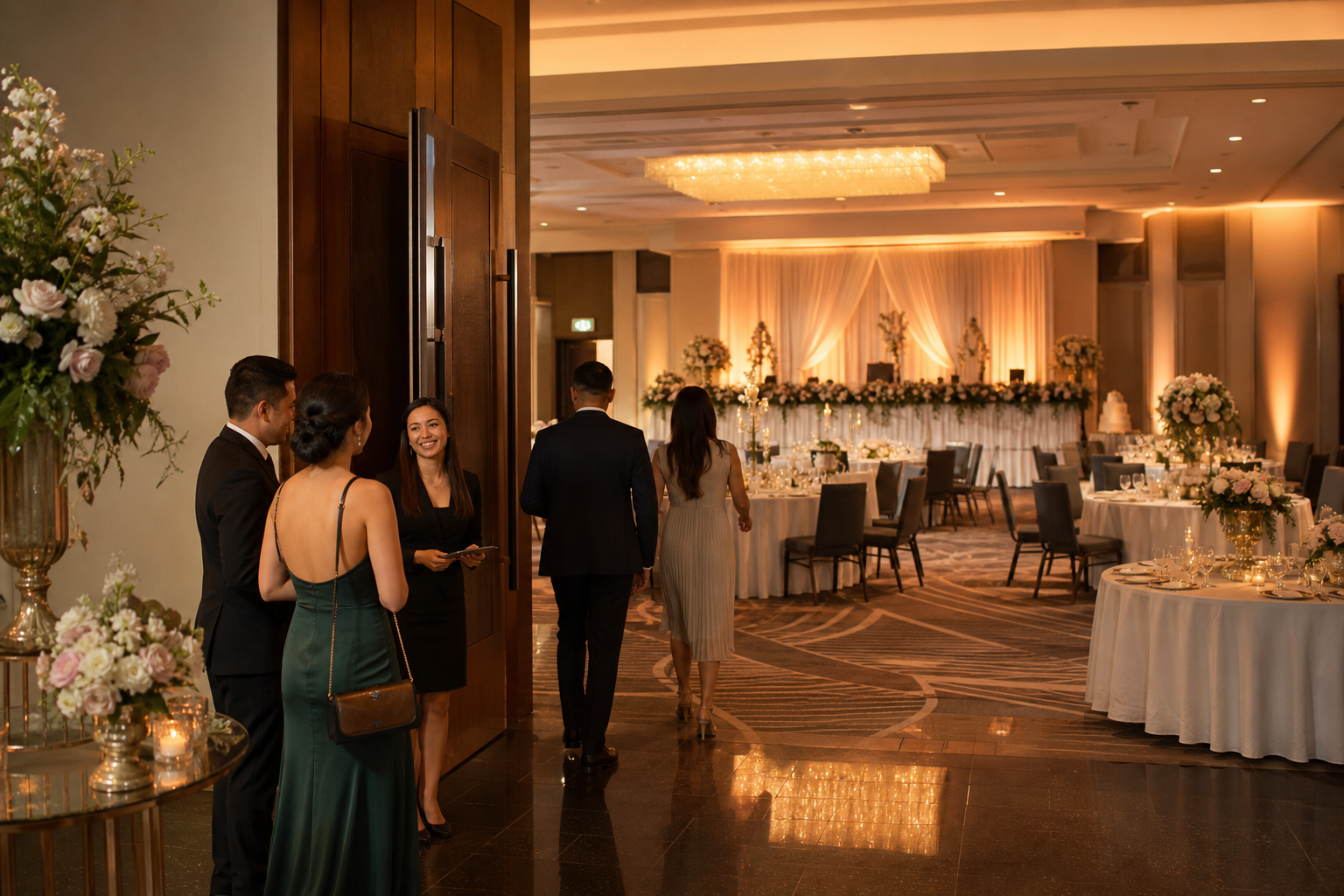
Guests moving from a cocktail area into a prepared wedding dinner ballroom with staff guidance

Separate guest-facing timing from behind-the-scenes access. Guests need a clear arrival point, while vendors need time for setup, sound checks, décor, catering preparation, and photography details. Confirm the actual access window with the venue instead of assuming a standard time.

Map the route from parking or drop-off to the welcome area. Include signage, accessible paths, restrooms, coat storage if applicable, welcome drinks, and the guest book. Before finalizing this section, use these wedding venue checklist questions to verify capacity, layouts, catering policies, AV, outdoor plans, and contract details.

2. Plan the ceremony-to-reception transition

The transition changes depending on whether the ceremony and reception share a venue. Confirm whether guests move directly to cocktails, whether the reception room needs a reset, and where formal photographs will take place. For separate locations, include travel, parking, directions, and late arrivals.

Do not treat photography as an undefined gap. List the required groups, gathering contact, location, and deadline. If guests enter the reception room before photographs finish, decide whether the MC, venue team, or a family member will manage the transition.

Review these wedding venue decisions to align guest count, format, travel logistics, room layout, and booking deadlines.

3. Define what happens during cocktail hour

Cocktail hour may absorb photographs, room preparation, guest mingling, welcome drinks, appetizers, entertainment, cultural activities, or a receiving line. Write down what guests should experience and where each activity occurs.

Keep entertainment away from congested entrances, clarify when the reception entrance begins, and confirm routes, lighting, accessibility, and weather arrangements for outdoor spaces. If the couple will be absent, tell the photographer and MC where they will be and who communicates the next cue.

4. Match the meal format to the running order

Plated service, buffets, stations, and family-style meals create different movement patterns. Show when guests are seated, how tables are served or released, when dietary meals are identified, and when dessert or late-night food is expected.

Coordinate speeches and introductions with the caterer. With stations or buffets, decide whether formalities should happen before guests leave their tables and ensure lines do not block entrances or the dance floor. Family-style service may require additional table space and careful décor placement.

Confirm dietary requirements and service details with the catering team. South Asian, Pakistani Halal, Middle Eastern, Sri Lankan, Caribbean, and Continental menus may require specific questions about labeling, delivery, guest communication, and timing.

5. Place speeches, entrances, and formalities where guests can follow them

Group formalities thoughtfully so guests can pay attention without feeling that dinner is repeatedly interrupted. Possible elements include wedding party and couple entrances, welcome remarks, speeches, toasts, cake cutting, first dances, parent dances, and presentations.

Decide whether speeches happen before dinner, between courses, or afterward. The best choice depends on guest attention, meal format, speaker count, and service sequence. Record the speaker order, approximate length, microphone type, and presentation cues.

The MC owns public cues, the venue or catering lead confirms readiness, and the AV lead manages microphones, music, screens, lighting, and staging. A technical check can prevent missing equipment or incorrect cues.

6. Build cultural and personal traditions into the schedule

Plan cultural and personal traditions as core program elements. A baraat-style arrival, family introduction, special dance, live performance, religious observance, outfit change, or extended photography session can affect guest movement, staging, music, catering, and formal entrances.

For each tradition, record who participates, where it happens, what equipment is needed, how guests receive instructions, and what follows it. If a performance needs a stage, open floor, lighting cue, or rehearsal, include those requirements in the venue discussion.

Share the schedule with family members and performers early. They should know where to be without relying on the couple for instructions during the reception.

7. Plan the closing sequence and protect buffer time

List the final dance, announcements, guest departure, transportation coordination, personal-item collection, vendor strike, and teardown responsibilities. Confirm which tasks happen while guests remain present and which wait until the room is clear.

Add buffer around guest movement, photographs, room changes, meal service, outfit changes, performances, and outdoor activities. The right amount depends on guest count, layout, vendors, and venue rules, not a universal formula.

Identify who can make timing decisions if the schedule changes. The couple may be unavailable, so the MC, venue lead, or another agreed decision-maker should know when to shorten, delay, or reorder an activity.

A flexible wedding reception timeline example

This is an illustrative framework, not a universal hour-by-hour schedule. Adjust it for the ceremony location, access rules, meal format, traditions, photography plan, and required end time.

Time block Activity Lead Planning check
Arrival window Guest arrival, welcome area, parking, and wayfinding Venue lead Are entrances, signage, and accessibility routes clear?
Transition Ceremony conclusion, photographs, and guest movement Photographer and family contact Who gathers participants and directs guests?
Cocktail period Drinks, appetizers, mingling, and entertainment Venue and catering team Is the reception room ready?
Entrance Guest seating, wedding party entrance, and couple’s entrance MC and entertainment lead Are music, lighting, staging, and sightlines ready?
Meal Remarks, dinner, service flow, and dietary meals Caterer and MC Does the formalities plan match service?
Formalities Speeches, dances, cake cutting, and cultural elements MC and AV lead Are speakers, microphones, and cues prepared?
Open celebration Dancing, dessert, and guest interaction Entertainment and venue team Is guest flow clear around food and activity areas?
Closing Final dance, announcements, departure, and wrap-up MC and venue lead Who manages transport, items, and the room check?

Venue and vendor confirmation checklist

  • Room and sightlines: Confirm the floor plan, tables, dance floor, stage, head table, photo areas, and guest pathways.
  • Catering flow: Confirm seating, service sequence, dietary meals, stations, speeches during dinner, dessert, and cultural food requirements.
  • AV and staging: Confirm microphones, music cues, screens, lighting, staging, power, technical support, and rehearsal timing.
  • DĂ©cor and outdoor plans: Confirm setup responsibilities, permitted dĂ©cor, patio access, lighting, weather backup, and indoor alternatives.
  • Arrival and access: Confirm vendor access, delivery windows, parking, drop-off, accessible routes, signage, and storage.
  • Contract details: Review event end time, setup and teardown requirements, included services, change deadlines, and restrictions.
  • Final walkthrough: Review the layout, timeline, menu, technical plan, and responsibilities. Identify who approves day-of changes.

Frequently asked questions

How much buffer should a wedding reception timeline include?

There is no single correct amount. Add buffer where people must move, gather, change clothes, complete photographs, reset a room, serve food, or prepare equipment. Ask vendors where their process is most sensitive, then avoid filling every minute with formalities.

When should speeches happen?

Speeches can happen before dinner, between courses, or afterward. Choose the placement that fits the speakers, guest attention, catering sequence, and AV setup. Give the MC and caterer one agreed order.

How do cultural traditions change the running order?

They may change entrances, music cues, performances, staging, family participation, food service, and photography. List each tradition as its own activity and confirm its space, equipment, participants, instructions, and following transition.

What must the venue confirm before the timeline is final?

Confirm room access, layout, sightlines, catering, dietary arrangements, AV, staging, lighting, décor rules, outdoor plans, parking, vendor access, contract requirements, and the final walkthrough. Agree on who can approve changes.

Turn the checklist into a shared running order

The strongest wedding reception timeline is specific enough to guide every transition but flexible enough to absorb normal changes. Build it around arrival, ceremony transition, cocktail hour, meal format, formalities, traditions, and closing. Then assign an owner, cue, and planning check to each part.

Circulate one approved version to the couple, MC, venue, caterer, photographer, entertainment team, technical lead, and anyone managing family or cultural traditions. A shared running order makes dependencies visible and gives everyone a clear response when timing changes.

For couples planning a reception in Mississauga, Mississauga Convention Centre offers wedding reception and ceremony spaces with in-house catering, AV systems, lighting, staging, décor options, and an outdoor patio option at 75 Derry Road West.

Key Takeaways

  • The wedding reception timeline should be flexible yet structured, allowing for real-life changes while ensuring smooth transitions.
  • Assign clear roles to vendors and family members to manage transitions effectively.
  • Incorporate cultural and personal traditions into the timeline to enhance the guest experience.
  • Always confirm venue details and vendor requirements to avoid last-minute surprises.
  • Utilize a shared running order to keep all parties informed and aligned throughout the event.